
Is it useful for job hunting? I tried "Yonpita" and it turned out to be surprisingly accurate
Hello. I'm Miyoshi, the recruiter.
You often hear about "self-analysis" when job hunting, but when you actually try it, have you ever found yourself wondering what kind of person you really are?
In this context, I'd like to introduce a rather interesting self-understanding tool.
Yonpita ," which appears in the book "The Laws of Life" (by Toshio Okada) .
Whether you're writing your self-introduction or statement of purpose, or even after entering the workforce, there are many times when you'll find yourself wondering what kind of work style suits you best. Knowing your own way of thinking and behavioral tendencies can provide a starting point for thinking about how to cultivate your strengths. Also,knowing what kind of situations tend to stress you out and what environments you find difficult can help you take preventative measures and avoid mismatches.
What are the 4 types?
This diagnosis divides a person's personality and behavioral tendencies into four categories based on their "desire type."
・Commanding type (extroverted x concrete): This type has a strong desire to win and achieve results, and exhibits leadership and initiative.
・Attention-seeking type (extroverted x abstract): This type has a strong desire to be noticed, recognized, and relied upon, and values emotional connection.
・Idealistic type (introverted x abstract): This type values their own values and beliefs, and prioritizes inner satisfaction and the realization of their ideals.
・Principle-following type (introverted x concrete): This type has a strong desire to understand the mechanisms and laws of things, and values rationality.
The unique feature of this assessment isyour personality from the perspective of what desires you are most likely to respond to. Everyone is unconsciously driven by desires such as "this is how I want to be" or "this is how I want to be treated."
In other words, it's a very useful tool for understanding your own tendencies, such as what environments and situations you tend to thrive in, and what tends to cause you stress.
By simply answering a few easy questions, you can learn about your own thought and behavioral patterns. It's not as difficult as the so-called MBTI or Enneagram, and its ease of trying is also a major appeal.
I got diagnosed!
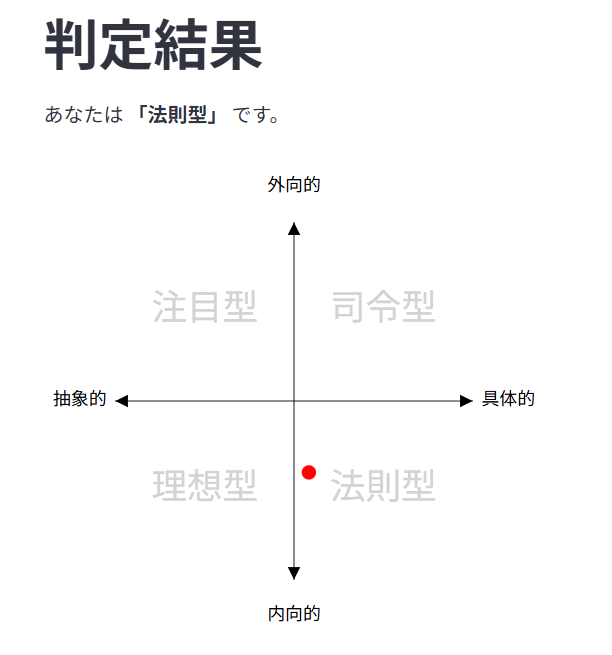
I actually tried it myself, and the diagnostic result was pattern-based !
It's true that I like to understand, speculate, and hypothesize about how things work and the rules of things (whether I'm right or not is another matter, haha). I also feel that I tend to think about things with an emphasis on rationality and whether they make sense. On the other hand, when I'm working on something, I want to be convinced of the background and mechanisms before checking the procedures and rules, and I can get a little flustered when something unexpected happens, so I see that as a weakness of mine
However, as I continued to read the diagnosis, I began to think that maybe there were some aspects of me that were similar to the ideal type. The feeling of measuring the distance between me and my ideal self, the happiness that cannot be decided by anyone, the freedom to live life in my own way, and the desire to engage in meaningful things are things that have always been inside me. That's why, given the position of my results, the expression "Law type leaning towards the ideal type" may have felt right to me
While the diagnostic results aren't everything, I think the interesting thing about these kinds of tools is that they can give you a chance to realize, "Oh, so there's this side to me too."
And it's important to have the perspective of knowing your own characteristics and how to make the most of them.
Prediction: There might actually be a lot of this type at Beyond?
I haven't actually had anyone in the company diagnose me, but judging from the atmosphere and communication style I get when working with them on a daily basis, I get the impression that there are a lot of people at Beyond who seem to be "rule-based" or "attention-oriented."
All employees at our company take the PCM (Process Communication Model) test, and judging from the results, it seems that many of us are closer to the Thinker (thinking-oriented) or Harmonizer (emotion-oriented) types. I get the impression that many of our employees are calm and value order and a sense of satisfaction, such as those who organize things logically and act with consideration for the other person's feelings
Of course, there are also people with leadership qualities, such as the Commander type, and creative people, such as the Idealist type, and I think that diverse perspectives, values, and roles are utilized in work and on the team. I feel that having a diverse range of types creates teamwork that recognizes each other's strengths and complements each other
Can it be used for job hunting?
Self-analysis is the first step in thinking about what kind of job suits you, but I think what's truly important is knowing when you can perform best and what kind of environment suits you
for example,
・Attention-seeking type: This type thrives on connections with others and recognition, so they tend to work more effectively in environments with lots of communication and workplaces where results are visible and feedback is readily available.
・Commanding type: This type excels in environments with clear goals and a competitive environment. They may find it easier to develop their desire for growth and initiative in positions with autonomy or in workplaces where results are emphasized.
・Idealistic type: This type seeks to find "meaning" and "value" in the work itself, so they may find it easier to maintain motivation in jobs that contribute to society or in workplaces where they can work on themes that align with their way of thinking and beliefs.
・Rule-following type: This type values logical systems and rationality, so they tend to feel stressed by vague instructions and haphazard responses. They should be able to consistently perform at their best in an environment where rules and procedures provide a sense of "understanding."
Through this assessment, you can understand your "tendencies," such as in what situations you tend to perform well and what kind of work environment you feel least stressed in, which should make it easier to choose a company and imagine your working style when job hunting. Please take this assessment as one of the diagnostic tools to deepen your self-understanding!
\At Beyond, we use TikTok to share information about the company atmosphere, recruitment, IT, and engineering. 💡The content is easy to watch, so be sure to check it out!/
@beyondjapan.24365
Additionally,corporate websiteandrecruitment websitecontain information about our business activities, services, employees, and recruitment events, so please check those as well.
Beyond Co., Ltd. Recruitment Site - Making the world a little easier -
Well then




The person who wrote this article
About the author