

How to approach systems after learning from multiple migration cases regarding the black boxing of enterprise systems
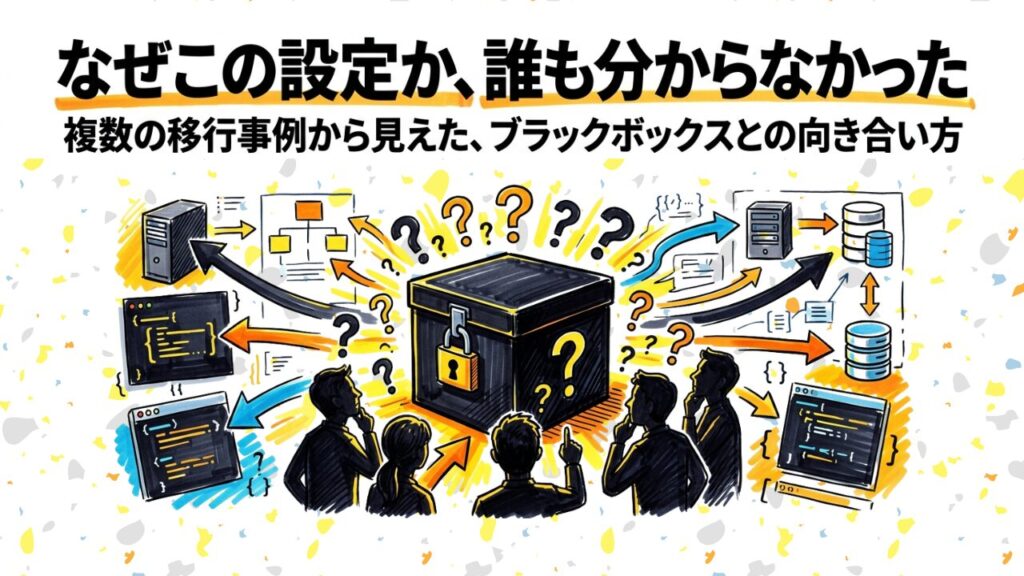
table of contents
One of the most troublesome challenges in infrastructure operations dealing with systems that have become black boxes .
In this state, the system faces challenges such as the lack of clarity regarding who made which settings, when, and why, resulting in an unclear identification of responsible parties, and the risk of disrupting its current stable state due to the fear that something might break if changes are attempted
Many people in charge of systems feel paralyzed by the increasing black-box nature of the system, even though they believe the problem needs to be solved. However, neglecting the issue only postpones the risk. In this article, we will explore the true nature of black-box systems and the thinking required to dismantle them, based on actual implementation examples we have worked on
Why do systems become black boxes?
The black-boxing of a system is not a result of negligence or malice on the part of the person in charge. Rather, it is something that gradually progresses as a result of doing the best possible thing in daily operations to keep the service running smoothly
Why do systems that should be transparent end up being opaque? We will explain the main factors from three perspectives
A series of individual responses based on on-site judgment
When a system malfunctions, engineers are required to restore it as quickly as possible. However, this emergency response can potentially lead to the system becoming a black box
To resolve an immediate problem, we sometimes change settings or implement temporary fixes on the spot. However, after the problem is resolved, we often don't have the time to document the details of these changes, and "why that setting change was necessary" remains only in the memory of the person who handled the issue.
Furthermore, as individual expertise increases—including unique operations and decision-making criteria understood only by specific personnel—areas become invisible or difficult for other members to access
When this series of actions is repeated without being shared internally, it becomes increasingly black-boxed
The intended purpose of the setting is lost over time
Even settings that had a valid reason at the time of their introduction can become meaningless over time as the business environment changes
For example, security restrictions that were only necessary for a specific period or for a campaign several years ago may remain in place without being removed
After some time has passed, the fear of "not knowing what will happen if I delete this setting" leads people to leave the old settings as they are and simply layer new settings on top of them. As this process is repeated, the internal mechanisms become intricately intertwined, resulting in a situation where no one can grasp the overall picture.
Prioritizing stable operation leads to avoiding change
When a system is running stably, we tend to become less inclined to clean up its internals or update it to the latest version. As a result, new versions are released before we even realize it, and before we know it, the version's end-of-life (EOL) is approaching. This happens quite often
As the system continues to operate, it becomes increasingly complex, and even minor changes increase the risk of unexpected malfunctions. As a result, fundamental improvements and streamlining tend to be postponed, and the focus shifts entirely to maintaining the status quo
In this way, areas that no one fully understands and that no one dares to touch gradually spread throughout the system
Three patterns seen from case studies
In the cases we have actually supported so far, there was a common "moment of facing a black box," so we would like to introduce it along with actual customer feedback we have received
1. We can't figure out the secret recipe for our sauce from the past (Major media company)
When we began investigating during the server migration, we discovered that the previous maintenance company had implemented multiple layers of unique configurations
"There were more black box aspects than we anticipated, and it took a considerable amount of time to unravel them." The essence of the migration project is not simply moving data, but rewriting this "secret sauce" into a modern, standard recipe
2. It's natural that the content is different (Game operations company)
We've also received feedback such as, "In business models where services are taken over from other companies, black boxes are commonplace."
"It's only after receiving the account that you realize the diagram and the reality are different." The important thing is not to be afraid of discrepancies. A proactive approach of "taking the plunge, confronting the problem, and only then gaining a deeper understanding" will ultimately lead to the quickest understanding
3. A state of being "stuck" due to fear (Web media company)
This is a case where, despite knowing about the aging of the OS and plugins, no action can be taken due to inadequate handover procedures
"I was afraid of bugs caused by the update, so I couldn't do anything." This "inability to move" is precisely the drawback of a black box that maximizes security risks
Three approaches to dismantling a black box
We value not only dismantling the black box, but also the process of ensuring that the same situation never happens again
① Visualize the "structure of reality"
Instead of blindly trusting the design documents, we verify each aspect of the current operating processes, network port status, and middleware configuration. Creating a diagram of the "actual configuration," rather than the "ideal state" envisioned during the design phase, is the first step in dismantling the black box
② Sharing knowledge through a "supportive" approach
Dismantling a black box poses irreversible risks if handled by a single company or individual. By working alongside our clients to address these challenges, we can share our knowledge regarding black box dismantling and implement approaches to prevent recurrence
As one client commented, "Beyond's knowledge combined with our research made for a productive work in solving the problem together." By combining a professional perspective (objectivity) with the client's perspective (domain knowledge), it is only by doing so that we can safely unravel the underlying issues
③ "Asset creation" beyond demolition
Instead of locking the dismantled knowledge back into someone's head, we redefine it as IaC (Infrastructure as Code) and up-to-date documentation. This transforms it into an infrastructure that anyone can access and improve after the migration
summary
Not knowing something is neither shameful nor a risk. The biggest risk is leaving it unresolved because you don't know
Multiple examples demonstrate that sharing the "unknown" and working together to understand the system fosters both a deeper understanding and team growth . The completion of the migration is not the goal, but merely the starting line for stable new operations.
If you're dealing with a system that you're afraid to touch, why not start by opening that door together?
Cloud infrastructure service information
Beyond's cloud server support will support your infrastructure as a partner who will work with you to solve any problems you may have.
Cloud Server Design & Deployment
Cloud server operation, maintenance and monitoring
 2
2 Loading...2



The person who wrote this article
About the author