

Kaspersky released an open-source antivirus tool, so I tried it out (Kaspersky Virus Removal Tool for Linux)

Hello.
This is Kawai from the System Solutions Department,
and we're experiencing memory depletion this morning
I've recently been looking for a good open-source antivirus software product, and I
Kaspersky Virus Removal Tool for Linux " released by the famous Kaspersky company around June. I was curious about it, so I decided to do a quick test of it and write this article as a memo for myself.
download
■ Verification environment
Ubuntu 24.04 LTS Kaspersky Virus Removal Tool 24.0.5.0
I'll download it right away from the following link:
https://www.kaspersky.com/downloads/free-virus-removal-tool
Basically, just follow the official instructions.
It's convenient because you don't need to install anything as you run it each time.
https://support.kaspersky.com/help/kvrt/2024/en-us/269465.htm
We'll try downloading from the browser, changing the permissions, and then running the file.
First, we'll try running it from the GUI.
$ cd ~/Downloads $ chmod +x kvrt.run $ ./kvrt.run Running with root privileges Generated directory is</tmp/9d208c686fe9d56312596> Verifying archive integrity... 100% SHA256 checksums are OK. All good. Uncompressing Kaspersky Virus Removal Tool 24.0.5.0 for Linux 100% ================================= Running kvrt with args <> ================================= compver: 24.0.5.0 x86-64 (Jul 9 2024 17:36:48) Product folder ----------------------------
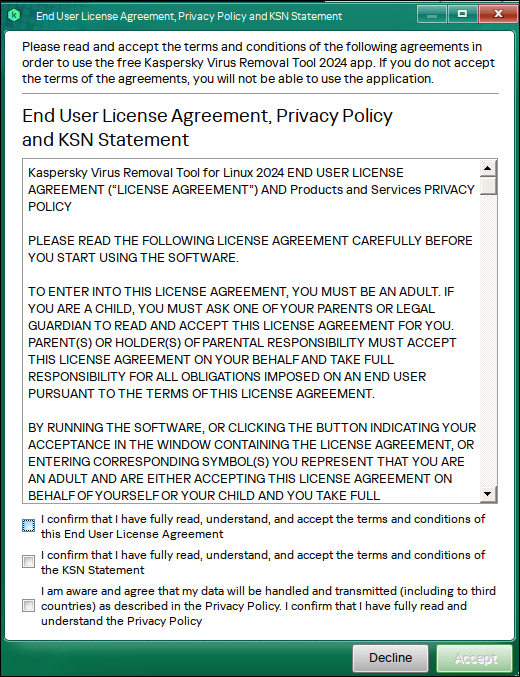
▼ The terms of use will be displayed. If you can confirm each one, check the box and proceed to the next step
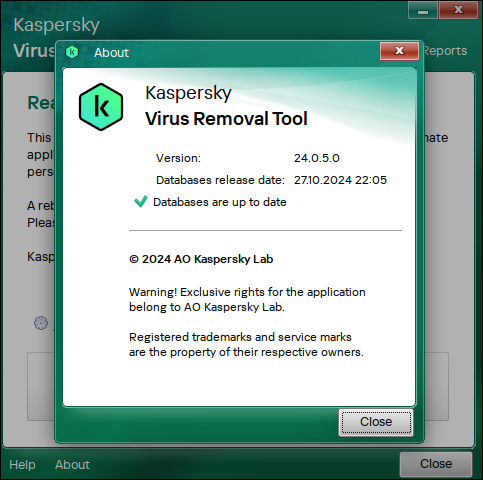
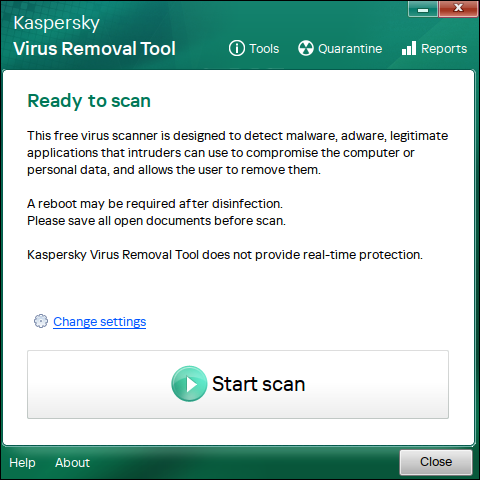
▼ The first time you install it, version information will be displayed. Once you have confirmed it, press Close and then click [Start Scan]
▼ Wait for the scan to run. Since I ran it on a clean image this time, nothing was detected
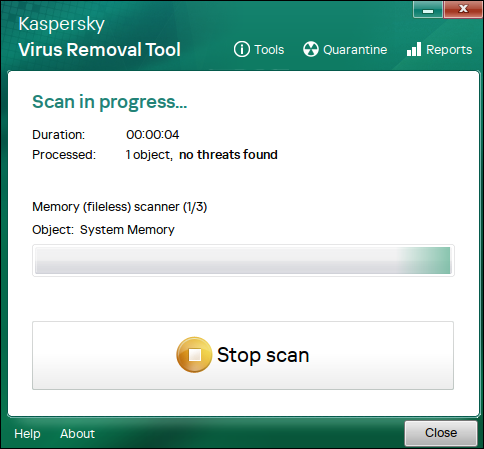
This tool can only be run on a spot basis and does not have real-time scanning capabilities.
Manual execution is fine using the GUI, but for scheduled execution, it is recommended to configure it with cron and run it via the CLI.
Next I'll try it via the CLI
Via CLI
First, check the help page:
https://support.kaspersky.com/help/kvrt/2024/en-us/269475.htm
-h - show help -d<folder_path> - path to quarantine and reports folder -accepteula - accept EULA, Privacy Policy and KSN Statement -trace - enable trace collection -tracelevel<level> - set the level of traces: ERR - only error messages WRN - warnings and errors INF - information, warnings and errors DBG - all messages -processlevel<level> - set the level of danger of object which will be neutralized: 0 - skip objects with high, medium and low danger level 1 - neutralize objects with high danger level 2 - neutralize objects with high and medium danger level 3 - neutralize objects with high, medium and low danger level -dontencrypt - disable encryption of trace files/reports/dump files -details - enable detailed reports -proxyconfig<config_file_path> - path to file with proxy config -silent - run scan without GUI -adinsilent - run active disinfection in silent mode -allvolumes - add all volumes to scan -custom<folder_path> -path to custom folder for scan -customlist<file_path> -path to file with custom folders for scan -exclude<folder_path> -exclude path from custom scan -excludelist<file_path> - path to file with excludes for custom scan -customonly - run scan of custom folders only
I'll try running it with the minimum options
-silent prevents the GUI from starting.
-accepteula skips the convention.
$ ./kvrt.run -- -silent -accepteula Graphical mode is<wayland> localuser:root being added to access control list Running with root privileges Generated directory is</tmp/92302b5bca4f82e716374> Verifying archive integrity... 100% SHA256 checksums are OK. All good. Uncompressing Kaspersky Virus Removal Tool 24.0.5.0 for Linux 100% ================================= Running kvrt with args <-trace -silent -accepteula> ================================= compver: 24.0.5.0 x86-64 (Jul 9 2024 17:36:48) Product folder ================================== Scan is started =================================================================== Scan is finished with results: Processed: 27957 Processing errors: 0 Detected: 0 Password protected: 0 Corrupted: 0 ================================== ================================== kvrt exited with code <0> ================================= localuser:root being removed from access control list
As with the GUI, nothing was detected
Try to detect malware
Next, let's try detecting malware.
As preparation, download the following file from the eicar website (to the ./Downloads directory):
https://www.eicar.org/download-anti-malware-testfile/
▼ Place the eicar file under Downloads
$ ls -l total 151296 -rw-rw-r-- 1 hamchan hamchan 68 Oct 29 10:26 eicar.com -rw-rw-r-- 1 hamchan hamchan 184 Oct 28 14:01 eicar_com.zip
This time, I will try running it by specifying it under Downloads
-trace Enables tracing.
-tracelevel Set to "DEBUG" to output all event logs.
-custom Specify the inspection directory.
-processlevel In this case, set to 3 to detect all threats in the low to high range.
./kvrt.run -- -accepteula -trace -tracelevel DBG -custom /home/hamchan/Downloads/ -processlevel 3 -silent Graphical mode is<wayland> localuser:root being added to access control list Running with root privileges Generated directory is</tmp/74a8bcf3a3339fc810150> Verifying archive integrity... 100% SHA256 checksums are OK. All good. Uncompressing Kaspersky Virus Removal Tool 24.0.5.0 for Linux 100% ================================== Running kvrt with args <-accepteula -trace -tracelevel DBG -custom /home/hamchan/Downloads/ -processlevel 3 -silent> ================================= compver: 24.0.5.0 x86-64 (Jul 9 2024 17:36:48) Product folder ================================== Scan is started ================================== Threat<EICAR-Test-File> is detected on object</home/hamchan/Downloads/eicar.com> Threat<EICAR-Test-File> is detected on object</home/hamchan/Downloads/eicar_com.zip> ================================= Scan is finished with results: Processed: 27961 Processing errors: 0 Detected: 2 Password protected: 0 Corrupted: 0 ================================= Action<Cure> is selected for threat<EICAR-Test-File> on object</home/hamchan/Downloads/eicar.com> Action<Cure> is selected for threat<EICAR-Test-File> on object</home/hamchan/Downloads/eicar_com.zip> ================================= Disinfection is started ================================= Disinfection action<Quarantine> for threat<EICAR-Test-File> on object</home/hamchan/Downloads/eicar.com> is finished with status<Quarantined> Disinfection action<Quarantine> for threat<EICAR-Test-File> on object</home/hamchan/Downloads/eicar_com.zip> is finished with status<Quarantined> Disinfection action<Cure> for threat<EICAR-Test-File> on object</home/hamchan/Downloads/eicar.com> is finished with status<CureFailed> Disinfection action<Cure> for threat<EICAR-Test-File> on object</home/hamchan/Downloads/eicar_com.zip> is finished with status<CureFailed> Disinfection action<Delete> for threat<EICAR-Test-File> on object</home/hamchan/Downloads/eicar.com> is finished with status<Deleted> Disinfection action<Delete> for threat<EICAR-Test-File> on object</home/hamchan/Downloads/eicar_com.zip> is finished with status<Deleted> ================================= Disinfection is finished with results: Processed: 4 Processing errors: 0 Skipped: 0 Quarantined: 2 Quarantine failed: 0 Cured: 0 Cure failed: 2 Cure on reboot: 0 Deleted: 2 Delete on reboot: 0 Restored: 0 Restore on reboot: 0 ================================== ================================== kvrt exited with code <0> ================================= localuser:root being removed from access control list
Judging from the logs, it appears the file was successfully detected, quarantined, and then deleted.
The file has also disappeared from the directory.
$ ls -lha drwxr-xr-x 2 hamchan hamchan 4.0K Oct 29 10:49 . drwxr-x--- 17 hamchan hamchan 4.0K Oct 29 10:44 ..
By the way, quarantined files are saved to the following location each time the command is executed (when executed as root)
$ sudo ls -l /var/opt/KVRT2024_Data total 24 drwx------ 2 root root 4096 Oct 28 13:52 Anomalies drwx------ 2 root root 4096 Oct 29 10:45 'Legal notices' drwx------ 4 root root 4096 Oct 29 10:49 Quarantine drwx------ 2 root root 4096 Oct 29 10:45 Reports drwx------ 2 root root 4096 Oct 29 10:49 Temp drwx------ 2 root root 4096 Oct 29 10:45 Traces $ sudo ls -l /var/opt/KVRT2024_Data/Quarantine total 12 drwx------ 2 root root 4096 Oct 29 10:49 KVRTQ0001 drwx------ 2 root root 4096 Oct 29 11:34 KVRTQ0002 drwx------ 2 root root 4096 Oct 29 11:41 KVRTQ0003
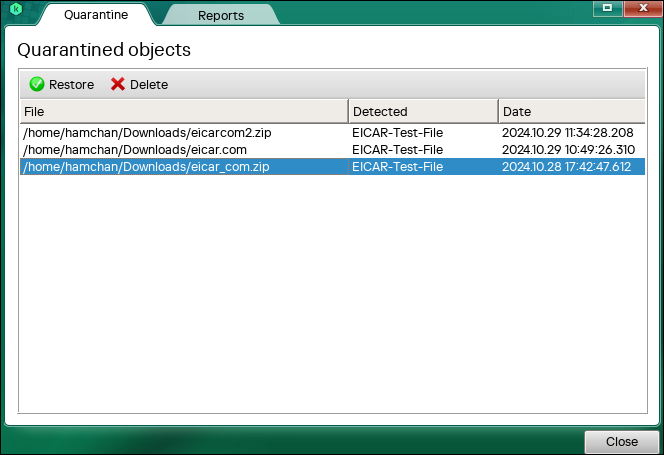
If you need to restore files due to false positives or other issues, you can do so via the GUI.
https://support.kaspersky.com/help/kvrt/2024/en-us/269476.htm
▼ Select a file from the list and perform the restore; the file will be restored to its original directory.
In summary, while it's simpler than commercially available software, the fact that it
's open-source and relatively lightweight makes it quite viable for personal use.
Microsoft has also recently released a Linux tool, so I'd like to test that out if I have the time.
complete




The person who wrote this article
About the author