
[Personality Test] I took the PCM test! Learn your own characteristics and use them in your work

table of contents
Hello
My name is Miyoshi and I work in recruitment at Beyond Co., Ltd
Speaking of my personal life, I recently went to Hong Kong and Macau.
It was my first time abroad in a year, and I found it really interesting to venture into unfamiliar places.
There's a lot to learn by experiencing things for yourself, rather than reading about someone else's experience online.
It was also fun to be able to have fun with people from other countries through the atmosphere and gestures, even though we couldn't communicate in the same language.
Now, getting to the main topic, I would like to talk about `PCM diagnosis
At Beyond, all employees undergo this assessment and training.
I enjoy analyzing myself and others, so I was looking forward to it.
The PCM diagnosis classifies people's personalities and communication styles into six characteristics and considers how to communicate effectively based on each person's "personality type.
In other words, knowing your "type" can give you hints on how to improve how you interact with others.
In this article, I would like to introduce PCM diagnosis based on what I noticed after actually undergoing the diagnosis
What is PCM diagnosis? - Overview of six characteristics -
As mentioned briefly earlier, the PCM (Process Communication Model) diagnosis is a communication model that divides people's personalities into six traits .
Each trait has its own way of thinking, behavioral patterns, and sources of motivation, and understanding your own and others' traits enables smooth communication.
Based on the idea that each person has a different communication style, each type has different ways of communicating and using their energy.
1. Thinker:
Thinks backwards from the goal and proceeds efficiently and rationally.
Creates rational patterns and order for themselves.
Good at planning and advance preparation.
Speaks calmly and with a neutral expression, and asks many questions.
2. Persister:
Actively expresses their opinions and enjoys debating with others.
Dedicates themselves to things they value.
Surrounds themselves with things that reflect their personal passion.
Speaks forcefully with a serious, confident expression.
3. Imaginer
: Calm and objective. Able to see the big picture, including themselves.
Has a rich inner world and prefers quiet solitude.
Given clear instructions, they will silently complete monotonous tasks without difficulty.
Speaks calmly and with a neutral expression, and does not take the lead in conversations.
4. Rebel
: "I do it because I want to," and for no other reason.
sharp intuition and inspiration, and has a free and flexible imagination.
- They simply love having fun.
- They express their emotions directly and speak expressively.
5. Promoter
- They are good at adapting to their environment and can handle pressure well.
- They have the negotiation and persuasive skills to motivate people to take action.
- They have an air of "I'm different from other people."
- They speak directly and succinctly.
6. Harmonizer
- They prioritize others over themselves.
- They value relationships with family and friends above all else.
- They are sensitive to the atmosphere, environment, and comfort, and value them.
- They have a soft smile and speak in a soft manner.
Source: https://www.kcj-pcm.com/6/
In addition, the PCM diagnosis uses the two concepts of "base" and "phase"
Base is a characteristic that represents a person's basic personality and values. It is said to be a person's innate temperament and is said to remain unchanged throughout their life. It is the foundation of their everyday behavior and way of thinking. Base characteristics are particularly evident when they are under stress.
Phases represent their current psychological state and source of motivation. They can change throughout life, and are particularly susceptible to change due to major events or changes in their environment. Because they are the characteristics that are most influential at the moment, they are most likely to be manifested in work and interpersonal relationships.
I had the PCM diagnosed!
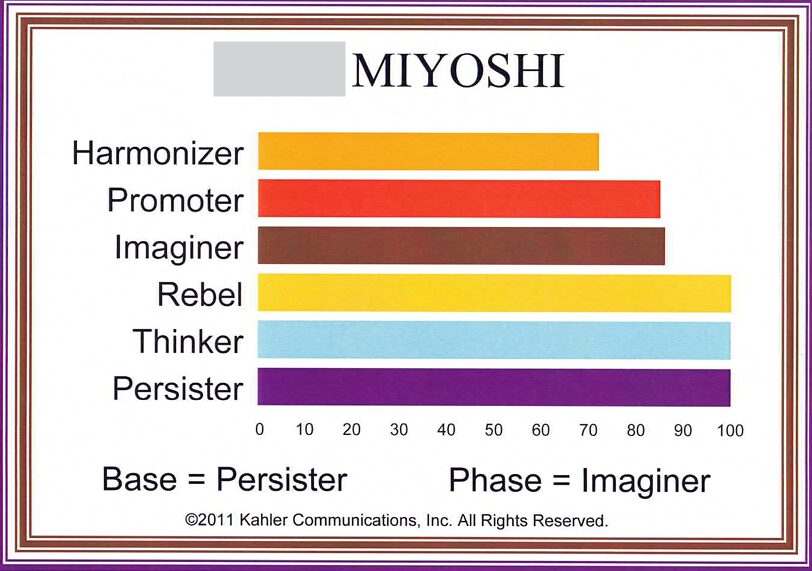 Well, my diagnosis was " Base: Passister " and " Phase: Imaginer ".
I also found out that my Sinker and Level were 100%, so it was a phase I had already cleared.
It's not all of it, but I think it's pretty spot on.
For the past two years, I've been interested in my inner world, and I'm definitely in a phase (Imagineer) where I enjoy giving shape to that worldview and expressing it.
When I was a university student, I liked fun things, and I think I was driven by the impulse to do things because I wanted to. (Level)
Looking back at my high school days, I was quite goal-oriented, so I didn't do things that I judged to be pointless, even if I didn't want to. (Thinker)
(Now I've gotten to the point where I can think that things that seem pointless at first glance aren't pointless after all.)
But I think they all have the qualities of a passer-up.
You're right (;・∀・)
What I noticed after the PCM diagnosis
After receiving the PCM diagnosis, I realized three major things
1. Being too cautious sometimes slows down my decision-making.
As a passive type at heart, I'm good at proceeding carefully in everything I do. However, being too cautious can slow me down. Even though I understand that taking action can change my impression of a certain event or subject and can teach me a lot, I tend to think more than act.
If I'm not prepared in many ways, I get scared and become cautious.
I've realized that sometimes I need the courage to "make a decision quickly" and "it will all work out."
2. The Importance of Moderate Thinking
Because Imagineers have their own unique perspectives, when they find it difficult to convey their emotions, they can be misunderstood when communicating with others or have difficulty conveying their true intentions. Strong emotions can also lead to them withdrawing into their own inner world. When you find yourself with overly unique ideas or turning your back on the world, you need to make an effort to come to your senses. I realized once again that having moderate thinking is important for building a balanced perspective and interpersonal relationships, while still valuing your own unique perspective.
3. Understanding the differences of others reduces stress.
I realized that it's important to try to communicate with others while taking their filter into consideration, both at work and in your personal life. Getting to know each other also makes it easier to understand each other's style. For example, if you have the traits of a "thinker" and value logical explanations, while the other person is a "harmonizer," you'll understand that an approach that values emotion and empathy is required. Being conscious of communicating in line with each other's styles can help reduce miscommunication.
At the same time as I learned about my strengths, I also realized that I still lack the qualities of a harmonizer and promoter, which are areas I need to consciously develop from now on
summary
The PCM diagnosis was very interesting!
I found it fascinating that by learning about my own characteristics, I can further develop my strengths and think about how to address my weaknesses.
My personality type is unusual, and the instructor said that because I'm not the majority, I tend to express myself in negative terms. I felt that a balance between individuality and harmony was necessary. What makes you happy may not make others happy, and vice versa.
It's difficult to truly understand sensations and vocabulary that don't exist within you, but I think the PCM test helped me understand the thought processes that people have.
We would like to use the PCM diagnosis in future recruitment activities and internal communications
If you join Beyond, you will definitely have to take this course, so please look forward to it

Attached is a photo of the mascot cat at a greengrocer's in Hong Kong
Well then
 3
3 Loading...3



The person who wrote this article
About the author