

Communication that doesn't make "obvious" a battle
Hi, this
is Kawai from the Systems Solutions Department, and
whether I can wake up in the morning is a matter of best effort.
It's April! Congratulations to all the new employees! ㊗️
This is the time of year I get most excited about; the weather is just right and warm, and the change of environment gives me a sense of freshness, which I love.
This year, Beyond has welcomed many new employees.
As a welcoming team, we want to do our best to ensure they enjoy their work while interacting with their colleagues.
Speaking of communication, one thing I want to focus on this year is "articulation."
This is a word we hear often these days, but it's a very important part of communication, so I want to be more mindful of it.
In this article, I'd like to change things up a bit and write about "communication that avoids clashing over 'the obvious'."
I hope it will be of some benefit to someone's perspective on work.
What is communication?
Let's start with communication.
This word is one of Beyond's core values, and you hear it often, don't you? We hear it
like "communication skills," "lack of communication," "proactive communication," and "smooth communication," and
it's become such a common word that we've even coined the term "drinking communication."
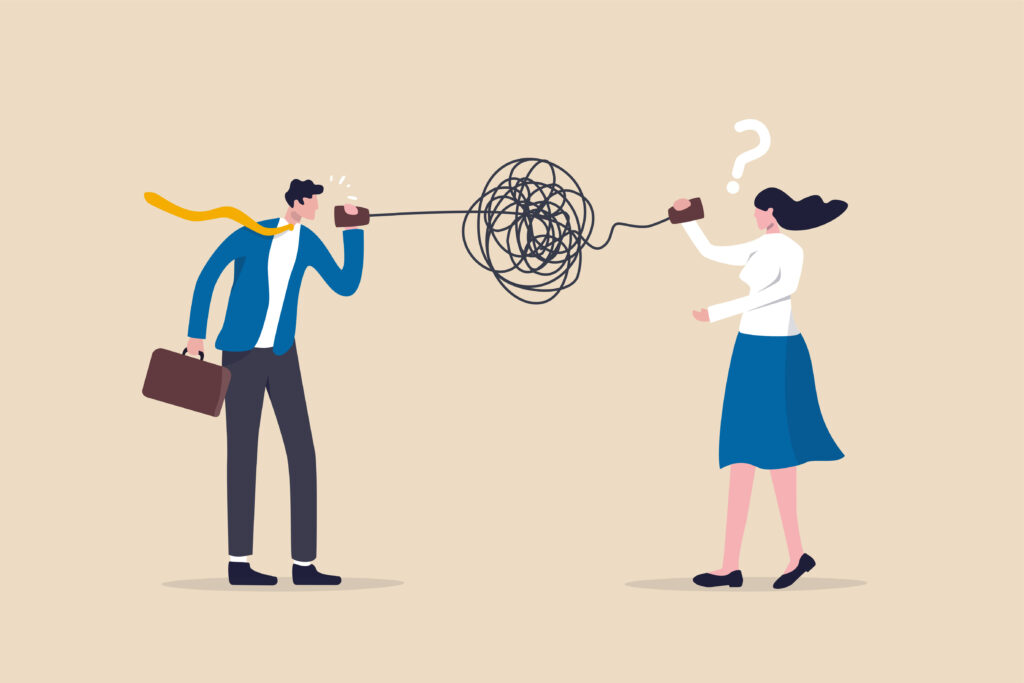
As you know, communication can be translated as "interaction of intentions," but I understand it to mean " conversations and actions taken to clarify and convey what one has imagined ."
For example, suppose Person A tells Person B, " If you're not getting along well with your colleagues, you need to communicate more
Does it mean that you don't talk to your colleagues enough? Or does it mean that you should invite them to after-work drinks? With just this information, it's hard to know what to do.
The reason why it's difficult to understand is thatthe definition of "communicating" varies from person to person.
Regardless of the word "communication," caution is needed with any word that has an ambiguous definition. Words like "please," "in a good way," or "more innovative" become easier to understand when paired with more specific expressions.
(Japanese, in particular, is considered a contextual language, meaning that even if subjects are omitted, the meaning can still be conveyed. Culturally, there's a strong tendency to "read between the lines," and this can sometimes be a hindrance.)
So, perhaps it would have been better if Person A hadgiven concrete advice (regardless of the content) like this: "If you're not getting along well with your colleagues, at least for work-related matters, make sure to report and communicate verballyas well as via chat. It might also be a good idea to deliberately ask them about things you don't understand."
The content of communication varies from person to person
The importance of verbalization

If you have understood the gist of this article from the previous section, please read to the end
This is about the verbalization I mentioned earlier .
When we talk about verbalizing something, I believe it really boils down to "clarifying an image." Secondly, it involves the communication necessary to achieve that image
For example, let's say an alert is triggered on the infrastructure side regarding a web server.
Person A asks Person B to "check the logs." So, what should Person B look at?
Let's say Person B, as instructed, checked the access logs. They initially outputted the number of requests for the last 30 minutes. When they reported this to Person A, they were asked, "Is that all? Did you investigate further?"Was Person B's investigation insufficient?
(※This conversation is fictional. In the actual Beyond, the question would be asked more gently.)
The answer is of course no
So how should you give instructions?
For example, if person A wanted to know the number of requests, which methods were most common, which destinations were most frequently used, and whether there was consistency in the source IP addresses, they should have simply stated that. They might even have wanted
system logs or load balancer logs to be examined. Also, the person who received the instructions might have thought that "it would be enough to just get the number of most recent requests from the access logs."
Verbalization is a way to minimize discrepancies between the person communicating and the person receiving the message, and making this process more efficient is communication。
Furthermore,communication is about eliminating the assumption that "this much should be understandable," while verbalization is about clarifying what "this much" means.
No matter how much we have a culture of unspoken understanding, we cannot see what is going on inside someone's head.
Communication that doesn't make "obvious" a battle
This has gotten a little long, but here's the main point and summary
Do you all have your own ``normal'' things?
To put it another way, think of it as individual standards that you consider to be "obviously expected
" In a work context, it's like the standards of "meetings should start 5 minutes early" or "customer calls should be answered within one ring."
By the way, don't you think this varies from person to person?
Some people might join a web conference 5 minutes before it starts, while others might join 1 minute before. Some people might even consider
arriving on time to be the standard. Some people might think it's fine as long as you're on time, while others might get angry and say, "How dare you not show up 5 minutes early!"The point is, what's "normal" varies from person to person.
As the title of this article suggests, it's pointless to pit these commonplace things against each other
However, just because everyone has a different sense of what's normal doesn't mean that things can stay the same. That's how human society works.
That's why rules exist, and explanations are needed to help people understand.
There are means and methods to prevent each other's "common sense" from fighting over each other, and the name of these methods is verbalization and communication
 I believe miscommunication occurs when things aren't articulated properly, or when you fail to adapt to the other person's assumptions—in short, when there's a lack of complete understanding.
If you're requesting an investigation into an alert, you need to clearly communicate what the target is, where and to what extent, by when the investigation should be conducted, and to whom the report needs to be submitted.
Communication is so important.
That's all, thank you for reading this far!
complete




The person who wrote this article
About the author