

Beyond held its 7th study session, "Game Development's [Super Cool] ~ Game API Development for Social Game Development"!

This is Ito from the infrastructure engineer and web marketing team.
We held our first study session of 2017!
Announcement:We will be holding the 7th Beyond Study Session! | Beyond Co., Ltd.
This time, we've borrowed the venue from Aiming Co., Ltd. , the company behind the popular game Logres of Swords and Magic !
As always, I'd like to share a little bit about what's inside!
First, here is a list of today's sessions
<tr>Company name Speaker name Session title
| Clover Lab Co., Ltd | Mr. Hatanaka | API development and usage with Go |
| Beyond Co., Ltd | Bandai | API Development with Phalcon |
| Aiming Co., Ltd | Mr. Uemori | Rails-API Way in Aiming |
API development and usage with Go
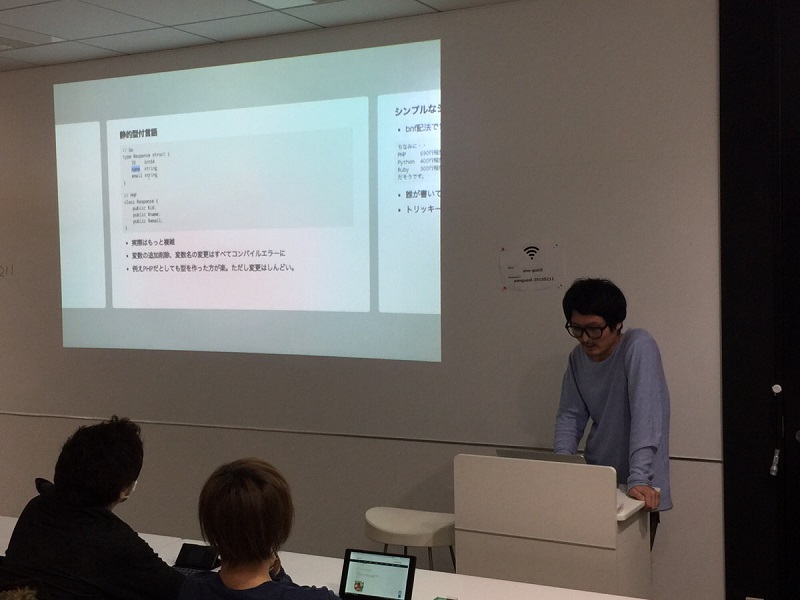
A session by Mr. Hatanaka from Clover Lab.
To be honest, the part he explained is actually available on GitHub (lol).
The materials for this session are here:
API Development and Use Cases with Go
Apparently, the entire backend of Wonder Crown is written in Go.
Wonder Crown: Seven Continents and the Forgotten Island Nation
Social game development is shifting from small-scale to large-scale projects.
This is where the Go language becomes useful.
- Static Tidying Language
- simple
- Multi-platform
There are other reasons as well, but that's it
Static Tidying Language
Go is a statically typed language, making
it ideal for large-scale development where many people will be working on it.
simple
Go is a simple language, making it easy to learn, and
resulting in code that looks similar no matter who writes it.
Multi-platform
With multi-platform support, you can view the same content regardless
of whether you're using Windows, Mac, or Linux
It's an era where Windows users and Mac users can get along.
Even though I'm explaining it, there's a source document, so please refer to that!
API development and its uses with Go
The presentation was incredibly easy to understand
because it displayed the execution results in the terminal right there !
API Development with Phalcon
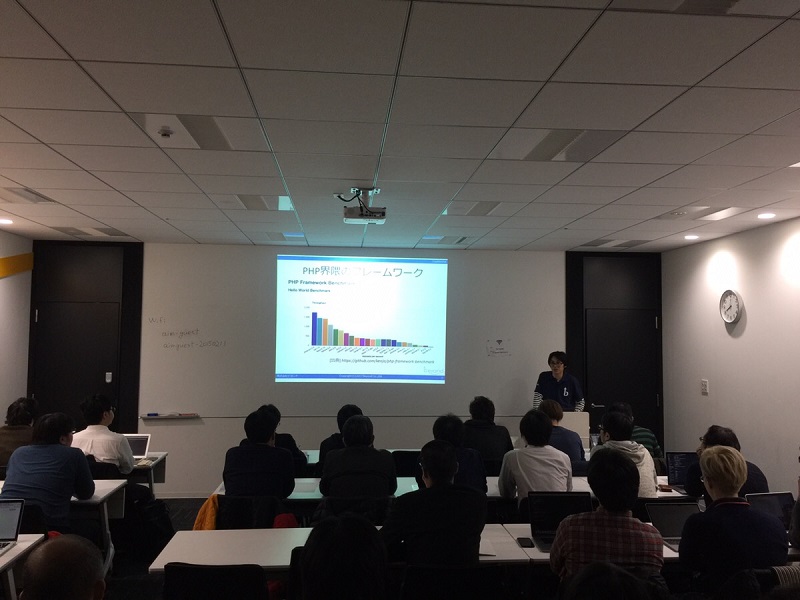
A session by Bandai from our company Beyond
This was an introduction to Phalcon, a PHP framework that is extremely fast
First, they introduced a list of popular PHP frameworks and their speeds, and
here are the top three.
- High Performance PHP Framework - Phalcon Framework
- Fast PHP framework | Ice framework
- Tipsy, an MVW PHP micro framework
Laravel and FuelPHP , which are commonly used (or so it seems) , are among the slower ones, and
"Anyone using Laravel is just being lazy" was born from that. My apologies to Laravel users.
The installation method is different from other frameworks;
instead of installing from GitHub, it can be installed using yum.
It employs a method of loading so-called shared library files into PHP.
It's written in C binary, so it's incredibly fast
ORMs are fast at internal processing, but they seem to struggle a bit with interacting with databases.
However, they seem to have other speeds that compensate for this.
The system supports a multi-module configuration,
making it easy to separate the source code for different parts of the system, such as the front-end and back-end, or for different API versions.
While it differs from installation to installation, the directory structure is similar to other MVC frameworks, and apparently
the learning curve for those migrating from other frameworks isn't that steep.
He also said that if the learning cost would result in an extremely fast framework, it would be worth the cost
So, let's all switch to Phalcon!
We're gradually adding Phalcon articles to our blog, so please check them out!
Phalcon | Beyond Inc.
Rails-API Way in Aiming
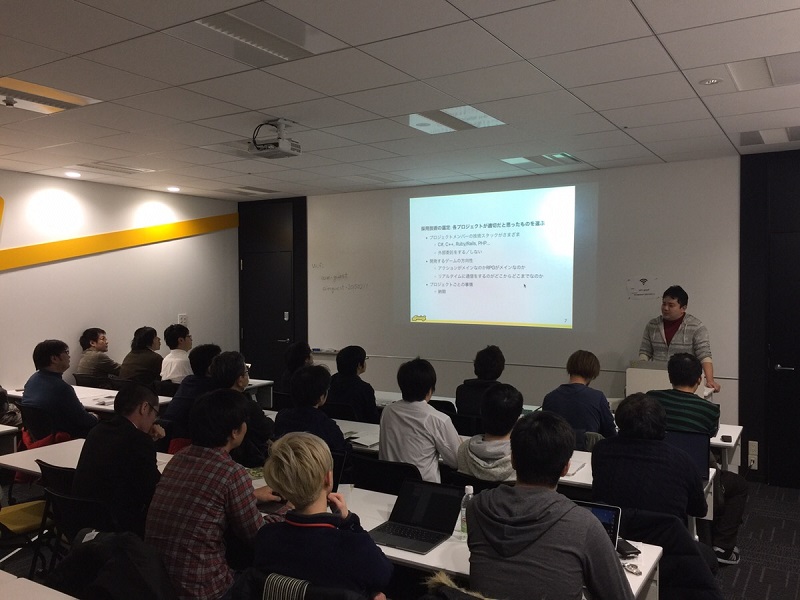
The final session will be by Aiming's Uemori
This is a story about "Aiming's style."
At Aiming, the language is decided for each project
, the client side is almost entirely developed using Unity.
Incidentally, the hugely successful gameLogres: Ancient Goddesswas developed using Cocos-2dx,
and that's because they started developing it when Unity's 2D capabilities were barely developed.
Also, parts requiring real-time processing are often written in C++ or C#, while
Web APIs are typically written in Ruby (Rails) or Python.
Logres, by the way, uses Python.
Aiming apparently uses RPC more often than REST APIs.
This is because they don't see many advantages to resource-oriented RPC, and they wrap and abstract the client-to-Web API communication,
so they don't need to be aware of the endpoint side.
Define the protocol
We've developed our own internal framework for defining the communication protocol between the Web API and the real-time server/client,
preventing each environment (client side, real-time server side, API server side) from implementing it independently.
If they did, we'd need to share various details across those environments.
This not only makes development easier, but also makes it easier to generate documentation and test clients, which is great!
Using Rails
A major factor in Rails' success is that it's an ecosystem; even complex implementations
can be simplified by using existing gems or referencing existing resources.
it has a well-defined architecture and abundant best practices,
making it easy to handle various issues.
However, performance may be inferior, so that's the trade-off
summary
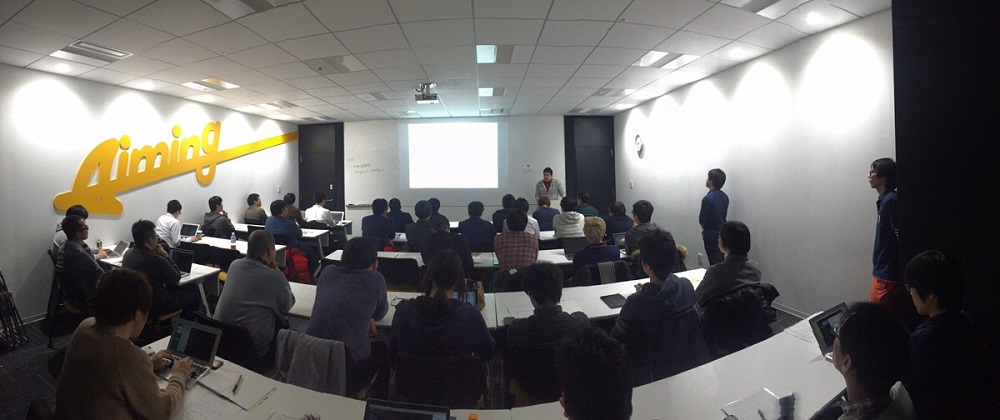
It's obvious, but I was reminded once again that different companies develop things in different ways.
By looking at the different methods used by different companies, we can select which ones are good to adopt and which ones are not.
Students sometimes attend our study sessions, and I wonder what they think of it.
By the way, Aiming's office is really clean..
See you in the 8th installment!




The person who wrote this article
About the author