
Passed AWS Certified Solutions Architect Associate
Hello everyone.
This is Hirata from the Systems Solutions Department.
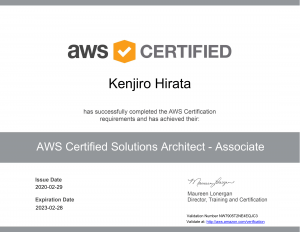
Having recently passed the AWS Certified Solutions Architect Associate exam,
I'd like to summarize what I did to pass it and my thoughts on the exam.
About the Author
- Joined mid-career for 6 months (several years as an infrastructure engineer)
- No experience working with AWS before joining the company (only self-study)
Study period
2 months (January-February 2020)
I learned that the Solutions Architect Associate exam would be revised after March 23, 2020, so I hastily started studying.
https://aws.amazon.com/jp/certification/coming-soon/
Therefore, the test I took was SAA-C01, not SAA-C02 .
What I did
Exam preparation books
AWS Certification Exam Textbook AWS Certified Solutions Architect-Associate
https://www.amazon.co.jp/dp/B07R1H87Y1/
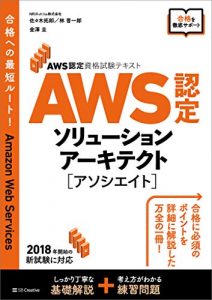
This is a great book for a first read.
The content is easy to understandand moves along quickly, so after finishing it
I felt like I had a complete grasp of AWS, but that was just my imagination.
Cram AWS Certified Solutions Architect Associate Last Minute Preparation Text
https://www.amazon.co.jp/dp/4798059463/
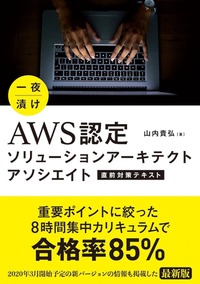
The chapter structure is unique, organized by AWS Well-Architected Framework rather than by service.
Therefore, you'll often find yourself discussing EC2, then Kinesis Data Streams, and
then EC2 again.
Because of this, some Amazon reviewers have given it harsh criticism, but
your second or subsequent AWSresource.
WEB problem collection
Learn with AWS WEB practice questions
https://aws.koiwaclub.com/
is a service similar to ping-t.
You can take over 935 SAA-C01 practice questions for a fee. The
questions are divided into units of 7, so it's appealing because you can work on them little by little in your free time.
Udemy AWS Certified Solutions Architect Associate Mock Exam Questions (5 Tests, 325 Questions)
https://www.udemy.com/course/aws-knan/
This is a practice exam with the same structure as the actual exam, anddifficultquestions.
I started taking it half a month before the exam, and I remember feeling despair when I couldn't pass a single question in the first week.
However, this was the most effective way I felt to prepare for the exam.
What I didn't do
When you're working, you have limited time to study, so you
inevitably have to be selective about your learning methods.
Here are some study methods that
are often mentioned in online success stories but that I didn't use this time
Udemy video lessons
Since I was tied up for a certain amount of time, it was difficult to study in my spare time, so I gave up
BlackBelt (Amazon online seminar)
at https://aws.amazon.com/jp/aws-jp-introduction/
because not everything is necessarily tailored to the exam.
AWS official practice exam
I decided not to take the exam because I heard a lot of information that it was much easier than the actual exam
Impressions of the exam
Difficulty
Due to the restriction of not disclosing the exam questions,
I cannot write about the details of the exam content, but
in terms of difficulty, it was comparable to the practice exams on Udemy.
The question text is long
The exam consists of 65 questions and is 140 minutes long.
Each question requires an answer of approximately 150-250 characters.
When I took the exam, I had 40 minutes left at the end, so I had plenty of time, but I was
exhausted and had no mental capacity to think clearly.
Sometimes it feels like you can't pinpoint the answer clearly
The exam is multiple-choice, but it's not always easy to pinpoint the correct answer.
Sometimes you can do what you want to do, but you're not sure which option is right.
In those cases, the problem statement usually
contains keywords such as
"Which method is more cost-effective?"
or
"High availability is required."
These terms are related to the Well -Architected Framework
which consists of the following five AWS design best practices:
* Operational excellence
* Security
* Reliability
* Performance efficiency
* Cost optimization
If you're having trouble with an exam, choose the option that most closely resembles these best practices
That being said, there were still quite a few problems I couldn't figure out
for example,
S3 Storage Class
When faced with a problem asking to choose between Standard and Standard-IA storage classes for S3,
the problem statement doesn't mention costs or frequency of use.
Scheduled Reserved Instances
When choosing how to purchase EC2 instances to run for a specific period,
the terminology is somewhat ambiguous, making it difficult to definitively decide on scheduled reserved instances.
SQS
Since application isolation requires processing order and duplication prevention,
SQS's FIFO would meet these requirements, but FIFO isn't explicitly mentioned as an option.
I think it's partly due to my lack of knowledge, but
, it might be best to just accept it
as "bad luck."
Comparison with three years ago
There was a blog post from one of our employees who took the same exam three years ago
Apparently, there weren't any workbooks or similar resources available back then, so they
seemed to be studying using the following methods.
- Try it out for yourself (attend official training)
- Take the official mock exam
- Read the official documentation
I was surprised by their completely different study methods.
It seems they basically only had official information to rely on.
Compared to back then, there are now many more reference books and practice questions available besides the official ones, and
I feel that the industry recognition of AWS certification has increased significantly in just three years.
Beyond, a company with many employees who hold AWS certifications,actively recruiting.
That's all




The person who wrote this article
About the author