
The ban on in-house side jobs lifted! The story of starting a cafe within the company
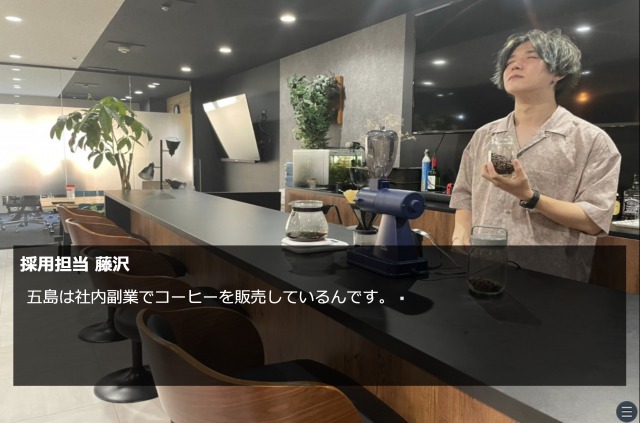
table of contents
- 1 What is the in-house side job system?
- 1.1 The impetus for the creation of this system: "You can make a profit, so try doing something within the company."
- 1.2 Why make a profit?
- 1.3 I tried opening a cafe in my company. Is it easy to have a side job in your company?
- 1.4 What was difficult about working part-time at the company?
- 1.5 What I experienced through my side job at the company
- 1.6 The essence of "delicious products" learned through a side job within the company
- 1.7 Is it profitable? The truth about working a side job in the office
- 1.8 Will I be able to learn something that I can use in my work?
- 2 [Summary] I'm glad I did it! Three benefits of working a side job in the office
Hello
Would you like some coffee?
I'm Goto, an in-house barista
(member of the Web Services Division)
Our company, Beyond, continues to develop various new internal systems, and we have now created yet another new system
This the in-house side job system .
*Beyond's previous employee benefits and systems are summarized in the article below
Beyond's employee benefits and internal systems [2021 latest version]
I love coffee so I took advantage of this system to set up a cafe within the company
In this article, we will provide an overview of Beyond's new "in-house side job system" share our experiences of actually working an in-house side job
If you are interested in unusual employee benefits or if you are thinking, "I would like to use my special skills to start some kind of business within the company,"
What is the in-house side job system?
The in-house side job system is an internal system that allows employees to develop some kind of business within the company for their own benefit .
By the way, if you were to develop something within your company, have you ever thought, "Wouldn't it be better to offer it for free or at a low cost without making a profit?"
Nomusin Shoten (which purchases pre-made sweets and drinks and sells them in-house), which has been in business since before this system was announced, sells its products at reasonable prices that make it clear that it is not trying to make a profit
Why won't Nomusin Shoten go bankrupt even during the coronavirus pandemic?
The title of this article is
"Why hasn't Nomushin Shoten gone bankrupt even during the coronavirus pandemic?" The answer, roughly speaking, is that Nomushin, aka Nomura from the development department, an incredibly nice person .
-What has allowed you to continue even though sales haven't increased?
I guess it's because I want to see everyone's smiles
In fact, they don't notice the deficit because they don't count sales
Once you count, it's over
Source: Why won't Nomushin Shoten go bankrupt even during the coronavirus pandemic?
(It's a really great store, and I almost always use it when I go to work.)
I also previously set up a photo studio as benefit
An in-house photo studio? A story of how employees created a benefit program
The impetus for the creation of this system: "You can make a profit, so try doing something within the company."
Until recently, it seemed like there was an unspoken understanding that we should develop something within the company as a kind of employee benefit without trying to make a profit (or at least that's what I thought), but
in April 2021 , our company president, Mr. Haraoka, said, "You can make a profit as long as you want, so I want everyone to try doing something within the company," and the in-house side job system was lifted .
I had always wanted to offer coffee within the company, even if it didn't make a profit, but when the company lifted the ban on in-house side jobs, I thought, "Wait, I can make a profit?!" and became even more enthusiastic about it.
With this background, I currently sell coffee drinks within the company under the name "Goto Coffee."
also appeared as Coffee Uncle a company briefing for a novel game released in September 2021
We have released the "Novel Game Company Guide" for 2023 graduates
In addition to Goto Coffee, the company currently also has
an in-house bartender an obanzai restaurant that serves snacks to go with drinks It seems likely that in the future, more and more employees will develop side jobs within the company.
Why make a profit?
The reason behind the lifting of the ban on internal side jobs seems to be that management wants to "create an opportunity for employees to develop a business sense."
Certainly, whether or not the premise is to make a profit will likely make a big difference in the content of the initiative
And maybe some sneaky thoughts will come up.
I once asked the CEO, Haraoka , "If it's okay to make a profit, won't there be people who try to do some really stingy business?"
"If we do that, no one will end up buying it, so it's probably a good idea," he said.
Although it is an in-house side job, this does not seem to be any different from actual market principles
I tried opening a cafe in my company. Is it easy to have a side job in your company?
The company's side job system was lifted with the aim of "creating an opportunity for employees to acquire business acumen."
To be honest, at first I thought, " Is it really that big of a deal?"
With these doubts in mind, I started a cafe within the company around May 2021
In conclusion, working a side job within the company was extremely difficult.
It's not easy to make a profit, and products don't sell as well as we'd like
With an in-house side job, your customers are people who already know you, so I think it's relatively easy compared to a business aimed at the general public who don't know anything about you, but it's still not easy to get into a situation where you can make a ton of money
From here on, I will introduce some of the difficulties faced a beginner in business
What was difficult about working part-time at the company?
By trying a side job within the company, you can experience the basic flow of business,
The main difficulties and challenges we faced in this endeavor were as follows:
1) Pricing: What is the appropriate price?
The first difficulty we faced pricing .
If you're just an ordinary office worker, it's rare that you get to decide the price of a product on your own
the price too low, you won't make a profit, and if you set it too high, no one will buy it.
Also, once a price is decided, it is easy to lower it, but if you want to raise it, you need to come up with a way to convince customers to accept the price increase .
This is why products in the world change their contents (quantity, etc.) instead of keeping the price constant
By the way, we are currently selling coffee at the following prices:
| Drip coffee (hot/iced) | 150 yen/cup |
| Iced Cafe Latte | 100 yen/cup |
What did you think when you saw this price?
A: It's cheap, right? Thank you!
B: Oh, convenience store coffee is cheaper? I see..
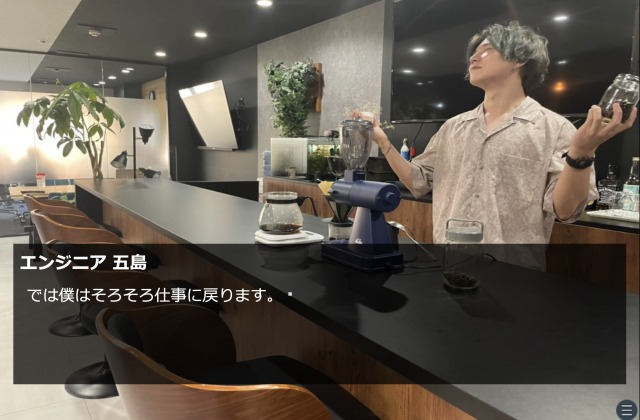
I would like to continue the story in a novel game style , please forgive me for continuing to talk one-sidedly
following points were considered as indicators when determining the price
- How much profit do you need to make per day to feel rewarded?
- What is the cost price?
- How much effort does it take to serve one cup? (How many cups can you serve per day in between work?)
After considering the above indicators, I initially vaguely thought, "The cost price is higher than I thought, so I'd really like to sell it for 250 yen, but I guess 200 yen is the limit..."
I suddenly asked the CEO, Haraoka, "I'm selling coffee as a side job within the company, but would everyone buy it if it was 200 yen?"
"Oh, isn't that expensive? No one will buy it if it's like this," I was told.
Uh, that's it..
the exciting "dream" turned into tense "battle (reality)."
I realized how the prices I had come up with on my own would not work in the market
The details of this will be discussed later as it relates to branding and purchasing
As mentioned above, we asked various people within the company, "How much would you be willing to buy it for?" while having them try samples, and we ultimately settled on the price mentioned above.
In the end, I think it was a process of finding a compromise between the price I wanted to charge and the price everyone wanted
By the way, we still receive opinions that 150 yen for drip coffee is expensive, but if we were to offer it for 100 yen, we wouldn't make any profit at all, so we have no choice but to offer it at this price
② Procurement of materials: Unable to purchase at wholesale prices

Regular cafes purchase large quantities of coffee beans at wholesale prices but this is not possible on the scale of an in-house side business.
This inevitably leads to higher costs
In order to keep costs down, you will have to purchase cheaper, lower grade beans, but if you lower the grade of the beans, you will not be able to serve the delicious coffee that you would like
By the way, the low-grade beans mentioned here refer to coffee beans sold at mass retailers, whose roasting date is unknown
oxidize
about two weeks after roasting , so I only buy about 200-400g of beans per week. By the way, oxidation is completed in eight hours !
For this reason, the coffee served in-house is always made using beans roasted within two weeks, and the beans are ground on the spot before being brewed
If they were simply pursuing profit I think they could have simply lowered the grade
In fact, when we asked people to try a coffee sample made with lower-grade beans once, although there were no dramatic reactions of "It's delicious!", there were also no comments that it was "bad."
For this reason, I was quite hesitant about whether to lower the grade of the beans, but I thought that if they were just going to serve decent coffee then there was no need for me to do it, so I decided not to lower the grade of the beans after all
Also, regardless of the grade of the beans used, it is difficult to make a high profit from selling coffee as a side business due to resource constraints, so
I thought that rather than just increasing short-term profits a little, I would be happier if word spread within the company that "Goto coffee is delicious."
③Branding: How do you make people feel the value?
My style of serving coffee involves carefully preparing each cup and serving it, I can't make a profit by selling a large quantity at a low price Therefore, it's important for me to make customers feel that my product has value so that they will buy it even if it's a little more expensive than the competition (convenience store coffee) .
I started making drip coffee when I was about 22 years old, and my love for coffee so strong not a day has passed since I didn't make drip coffee .
(Recently, I have started to offer not only drip coffee but also espresso.)
home whitening done for about two weeks last month two days I couldn't resist and immediately started drinking coffee.
gathering information and researching how to create a better taste is still essential to me.
Therefore, I believe that I am probably better at handling coffee than the average person, but I have no experience as a professional barista, so I am ultimately an amateur .
That's why, no matter how good the beans or equipment I use, my coffee is always compared to convenience store coffee
It's true that convenience store coffee is incredibly delicious considering the price.
It's not impossible
As of October 2021, our branding has not yet been fully implemented, so we will continue to think of ways to make people feel that our coffee has value
I would like to take this opportunity to introduce what I have been working on up to now
① Providing coffee trivia
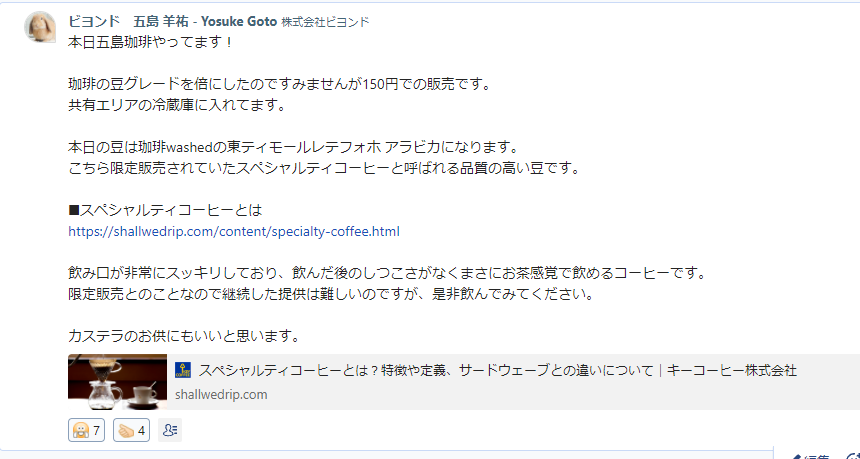
Many of our colleagues are not as passionate about coffee as I am,
so along with announcing the opening, I gave a presentation on coffee trivia (no, I'm not talking about dad jokes) and the unique flavors and aromas of the coffee beans we use.
I would love for everyone to deepen their love for coffee, but I'm careful not to become a nuisance who can't stop talking about coffee once he starts
② Designing the serving cups and taking image photos
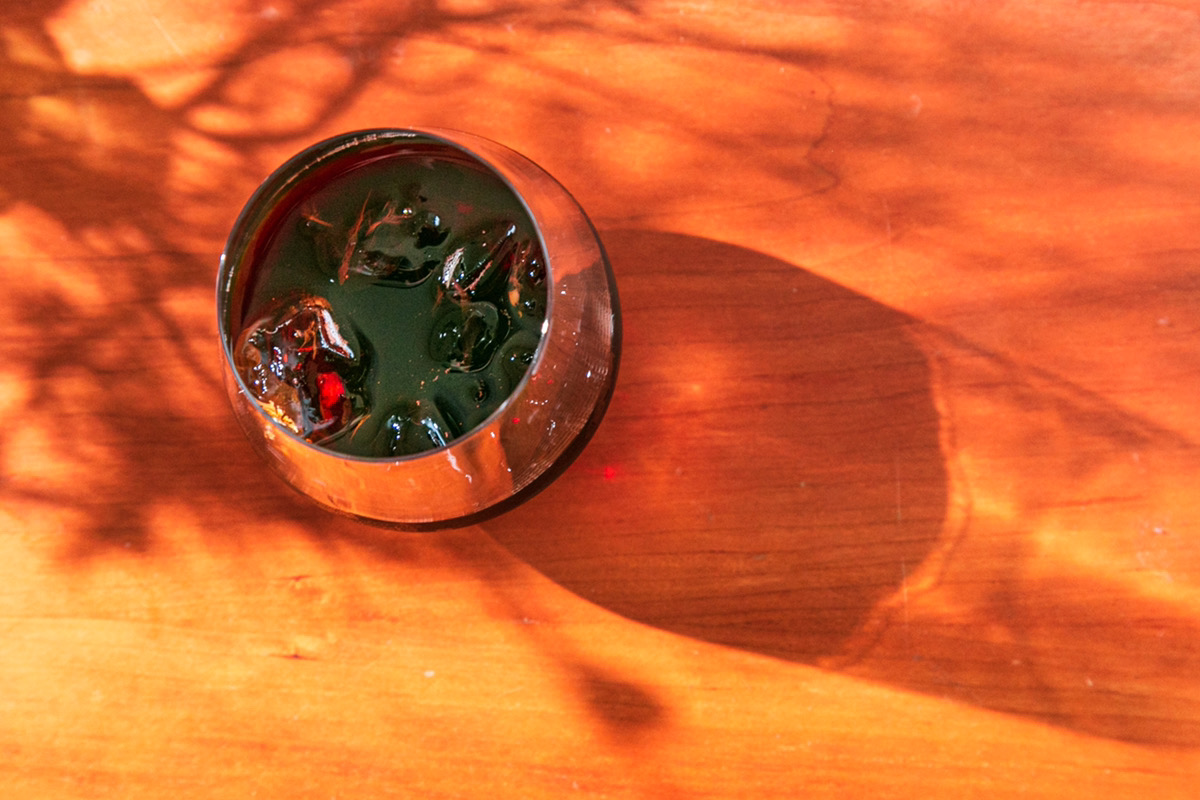
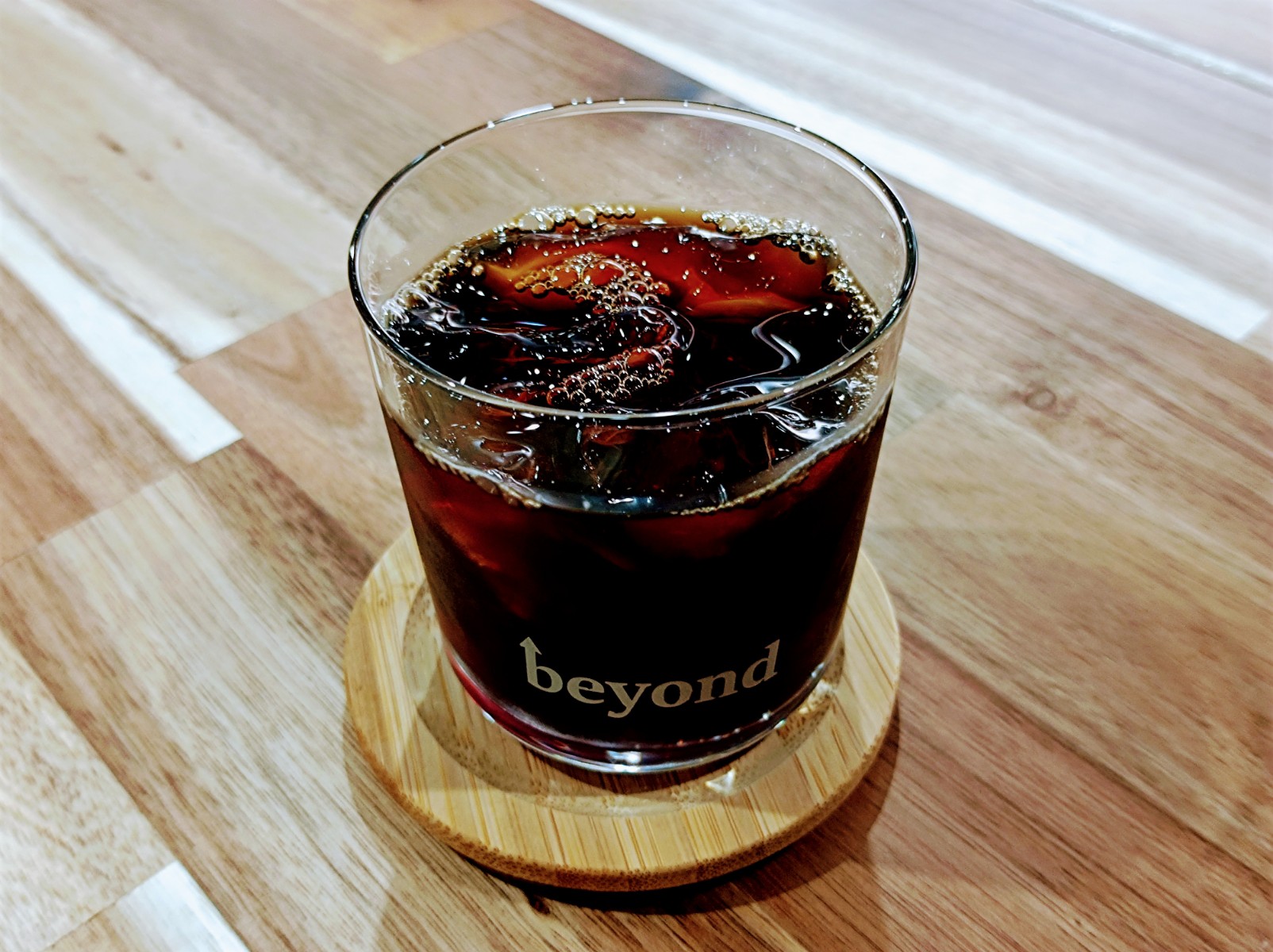
When we first opened, we served coffee in paper cups for convenience, but coffee served in paper cups had a
feel When it comes to food, the tableware used and how it's presented are very important. Even if the food tastes the same, I think the appearance can affect whether it tastes good or
Therefore, we now serve coffee in company glasses and in coffee cups brought by customers
Also, I have a bit of a career as a photographer, so I occasionally take photos that make coffee look delicious and publish them as image images.
That's fine, but I haven't taken any serious photos yet, so I'm going to try that sometime.
3. Uses unique beans that you won't find in convenience store coffee
Convenience store coffee is great value for money and delicious, but most of the time it uses beans that are not very distinctive and are easy for
everyone to enjoy has made efforts to differentiate itself intentionally using beans with a fruity aroma
By the way, the beans we often use are naturally roasted Ethiopian beans. They're truly delicious. The first time I tasted this flavor at an outdoor cafe, I was so shocked I remember drinking it almost every week. Ethiopian coffee, also known as "mocha," is probably the most representative of lightly roasted beans. Other famous beans include Kenya and Costa Rica. Incidentally, among the coffee beans commonly referred to as "mocha," there are those from Ethiopia and those from Yemen called Mocha Matari. Although both are called "mocha," they come from different regions, so their flavors are completely different. Also, naturally roasted coffee has an aroma that's almost like wine, and I've always wondered why coffee can be called wine..
…picture?
Oh, am I talking too much?
Okay, I'll leave it at that for now
4. For repeat customers, we change the flavor to suit their preferences
After serving coffee, I try to ask for feedback as much as possible, and the next time someone orders, I try to make a flavor that is closer to their taste .
I only realized this when I started serving coffee as a side job at the company, but taste preferences really do vary from person to person. What is "strong" for one person may be "weak" for another.
Through these efforts, we hope that people will be able to enjoy even more delicious coffee and feel like they would like to order again
What I experienced through my side job at the company
Although these are just my personal experiences, I would like to share three things that I felt were good experiences when trying out a side job within the company
①Cost calculation
I had never been involved in a business that incurs costs before, so this was my first time experiencing the task of calculating costs
I'm not good with numbers and I'm not very good at calculations, but I realized that as I calculated in detail, a lot of things became clear, and I found the time I spent calculating to be surprisingly enjoyable
When I didn't know how to do the calculations, I asked my mom
Also, calculating the cost price every time I developed a new product was a hassle, and I would forget how to do it, so I created a spreadsheet that would automatically calculate the cost price and profit margin based on the recipe and ingredient costs
② Pricing and research
As mentioned above, I don't often decide prices on my own, so it was a great experience to see
firsthand In particular, when I was working part-time in the company, many people would tell me if something tasted bad (too strong or too weak), or if it was too expensive, which was a learning experience.
If you run your store normally, there will likely be many cases where customers simply stop coming without a word, so this is a very easy problem to deal with
3) Research into customer needs
Until now, I have been offering coffee that I think is delicious to my friends and family , but at my side job in the company, I want people to pay to drink my coffee, so
I needed to serve coffee that everyone would think was delicious, not just coffee that I
When money is involved, both the seller and the buyer begin to view the product more critically, so I think this tension was an interesting point.
Specifically, in order to meet customer needs as much as possible, we tried to see which beans produced the best response, and instead of just offering black coffee, which is a little expensive and only available to those who are good at coffee, we kept costs down and offered cafe au lait and cafe lattes at lower prices so that even people who don't like the bitterness of coffee could enjoy them
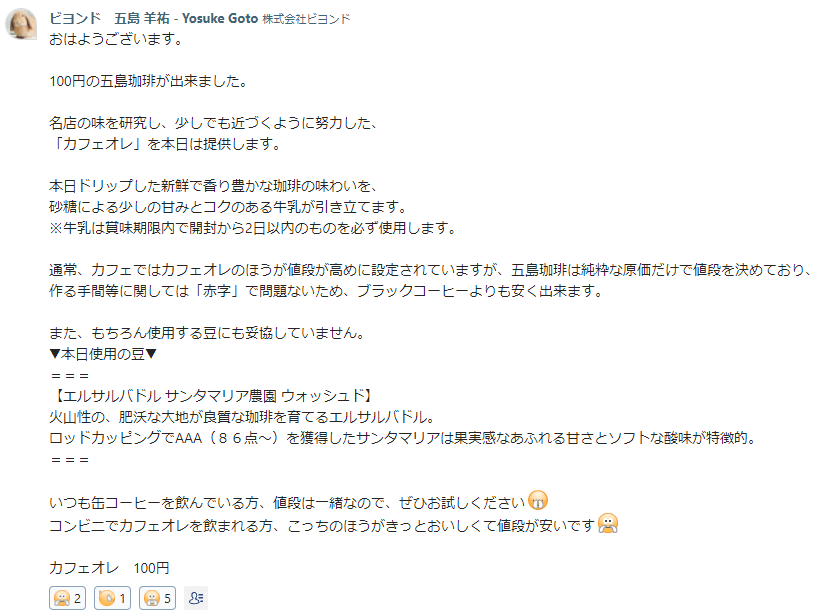
By the way, at first we offered coffee made with different beans on a daily basis so that customers could enjoy it, but as we saw people's reactions we realized that this was a bit of a self-indulgent way of offering it, so now we basically only use the most popular beans on a regular basis
The essence of "delicious products" learned through a side job within the company
This may be a bit sudden, but what do you think makes a delicious product
I used to think that a delicious product is one that many people find delicious
However, this was a mistake
If you are evaluating the food itself, the above may be fine, but if you are evaluating it as "product," taste alone is not enough as an evaluation criterion.
"Delicious" as a product refers to something that is highly rated overall, taking into account various factors such as taste, experience, and price
In other words, the "best-selling products" are the "delicious products."
There is a book that made me realize this
This is what Masakaki Yasuhiko, the founder of Saizeriya, wrote in his book "Food doesn't sell because it's delicious; it sells because it's delicious .
When I read it, I was bombarded with comments like, " Oh, so that's what it was all about!"
Beyond an in-house library , so when there is something you want to know more about, you can study it using carefully selected, high-quality books.
They also have the Tokyo Revengers manga on display.
I have always believed that if I could create a product that tastes good, many people would eventually buy it, and I have been researching flavors
I realized that if I wanted to develop a good "product," what price it should be at and when it should be consumed
Even if I say so myself, I think I've made some pretty typical mistakes that a beginner in business might make
I would like to use this experience to provide even better products in the future
Is it profitable? The truth about working a side job in the office
Well, I've talked about a lot of things up to this point, but what you're wondering is
I guess the question is, "So, in the end, are they making a profit?"
So I'll answer that question. Frankly, I'm not making any profit at all.
I believe there are three reasons for this:
- High cost
- Not many products are sold (average 3-4 cups)
- Since it's just a side job, I can't devote much time to selling coffee
That said, the experience of people paying money to buy something I've made is very satisfying, and I don't think making a profit is the only goal
By the way, I always use the profits I make from Goto Coffee to buy snacks from Nomushin Shoten, so I probably don't have anything left financially lol
As things stand, Goto Coffee is not yet profitable enough for me to be able to proudly call it a business, but with some ingenuity, I hope to be able to make enough profit to make it a shop that everyone is happy with, and that allows me to not only buy snacks from Nomushin Shoten, but also have ramen on the way home from work
We will continue to experiment in the future
Will I be able to learn something that I can use in my work?
I realized that the experience I gained from working part-time within the company was very valuable and interesting, but it might be a little difficult to directly apply that experience to my work
For example, I usually work in web marketing to increase customer acquisition through the web, but since Goto Coffee, my in-house side job, is only sold to internal customers, attracting customers from a website is completely irrelevant
That said, it seems like it all depends on how you do it. In the future, I'd like to work in a way that allows me to gain experience that will be useful in my main job. It might also be interesting to have new employees in charge of marketing-related work do a side job within the company for a limited period as part of their training
[Summary] I'm glad I did it! Three benefits of working a side job in the office
Working a side job within the company is not easy, but it can be a very interesting experience
Finally, to conclude, I would like to list three benefits that made me think that it was good to have a side job within the company!
① Learn the basics of business
You can start a business doing what you want to do, so you can take it personally and think independently, while gaining experience. Also, although it is a low-risk start, if it sells, it's all your credit, and if it doesn't sell, it's all your fault
Working in such an environment involves trial and error, which will naturally be the first step in acquiring basic business sense
② It's incredibly easy to create opportunities to make money doing what you love
It's generally said that it's difficult to make money doing what you love, but I think a side hustle within a company might be the easiest way to turn what you love into money.
In fact, I never thought the day would come when I would be paid for my coffee.
③ Opportunities for communication are created
This was a benefit for me, as I'm not a very talkative person and I'm not the type to talk to people that much. After someone orders a coffee, a conversation naturally starts in the five minutes or so while it's being served, and I think it's great that people get to know me through my coffee, and conversely, I get to know the person who bought it for me
That's all
Once the social situation has settled down, we would love to have people outside the company enjoy our food!
Thank you for watching until the end
 0
0 Loading...0



The person who wrote this article
About the author