
Working on psychological safety
table of contents
our Novel Game Company Guide
has been creating a bit of a buzz in certain circles recently I normally don't like being photographed, so I declined to appear in it, but after seeing the finished product, strong desire to appear in the next game . This is Sato from the System Development Department.
Well
"psychological safety is often heard these days . It is said to be important when working in a team. If you're wondering what that is and what it tastes like, you can completely ignore it!
Recently, all team members in the Beyond Development Department have begun working on
"psychological safety." This has been a great opportunity for me, as I'm not a "
spirited corn" who can work in a constantly stressful environment In this article, I'd like to write about what kind of mindset is important, based on what I've learned in training and books.
What is psychological safety?
It is
a state in which people feel safe to express their thoughts and feelings to anyone Google, a global company, also began working on this in 2012 and concluded that have lower turnover rates and higher profitability
It feels like killing
two birds with one stone I know what to do, and I do it all the time. That's what I thought.
The results of the team training..
It was quite different from what I thought. I'll do it seriously. Sorry m(_ _)m
Basic Concept
The goal is to create a team where members can exchange opinions in a healthy way and focus on doing productive, good work.
A team that can do this when working is said to have a high level of psychological safety.
However, the reality is...
human relationships are delicate, and the hierarchical relationships are harsh. No matter how hard you try, you don't get rewarded. There's no point in complaining. I just want to go home. And so on...
Most companies have various interpersonal relationships, more or less, and even if you understand it in your head, things don't always go as planned.
Many Japanese people don't want to cause trouble in the first place, and especially young people tend to lack self-confidence and end up being hesitant to say what they want to say. Poison.
Working towards a common goal, sharing ideas, and tackling problems together. That's what a team is all about. It's a shame when everyone has a great idea but it doesn't come to fruition
What should I do?
So,
let's think about how we can achieve these two points: exchanging opinions in a healthy manner
and focusing our efforts on productive and good work
First of all, in order to
exchange healthy opinions, for everyone, not just a few people, that they are welcomed, that people are listening carefully to what they have to say, and that good ideas are being properly incorporated.
>The results of the team training were...
>very different from what I expected. I'll try my best. Sorry m(_ _)m
regret that my expectations were so far off and that not everyone felt the same way.
In terms of specific ways of thinking and behavior, I would like to consciously start by changing these things
・Easiness to talk:
Talk, listen, respond, look the other person in the eye while listening to a report, engage in small talk, etc. ( This is what we call attentive listening・Helping each other and
asking for advice, giving advice, finding problems, enjoying trouble, asking for help, accepting help, etc.・
Creating opportunities for challenges, giving opportunities, trying things out, improving, devising new ideas, welcoming change, etc.
Welcome new ideas and individuality that accepts new things
As a result, you will be able to avoid being distracted by trivial things and not have your time taken up, and
you will be able to focus your energy on productive, good work
Important things
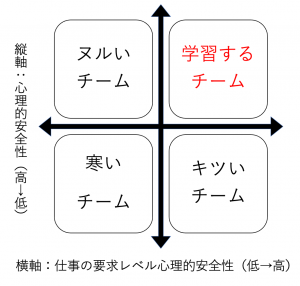
・Cold team→ My work is tough and I can't relax. Stress level: 100%・Tough team→ My work is rewarding, but I feel uneasy. Stress level: 70%・A weak team→I don't get told off even if I produce low-quality output, and deadlines are relaxed, so it's a comfortable place to workMy perceived stress level is 20% (but my productivity is so low that it's not recognized)Learning team→ There are difficult tasks, but somehow I can look forward. I want to work for a team that recognizes me! Stress level: 0-100%**When work is difficult, you may feel stressed, but don't let it drag you down. Learn from your mistakes
summary
It's quite a deep subject, so I this article only scratches the surface.
I think that because team members see each other every day and tend to take their presence for granted, they tend to assume that they understand each other without being told.
That's why it was necessary to consciously try to change the way we interact and get along with each other .
Now that online working is becoming more common, it may be time to reconsider casual communication
In the end, these words really fit!
"Everyone is different, everyone is good"
After this, I hope to be able to report back to you on how the team has fared as a result of changing our mindset and actions over the next six months or so
The development team has launched a website.
We offer a one-stop service for everything from server design and construction to operation, so if you have any problems with server-side development, please feel free to contact us.
SEKARAKU Lab: https://sekarakulab.beyondjapan.com/
See you next time!
Reference book: How to Create Psychological Safety (by Ryosuke Ishii)
https://www.flierinc.com/summary/2468 (I learned a lot! Thank you!)
 2
2 Loading...2



The person who wrote this article
About the author