

3 things to keep in mind when shooting YouTube videos [for performers]
table of contents
Thank you all for your hard work every day!
I'm Narita, in charge of planning, filming, and editing for Beyond Inc.'s official YouTube channel, "Biyomaru Channel"!
While working as a new marketer at Beyond, I also post videos on YouTube on my own!
This time, I'll explain the points I pay attention to when shooting videos! This information can be applied not only to YouTube filming, but also to public speaking such as presentations, so I hope it will be helpful
The difference between video shooting and presentations
Human eyes and cameras
The biggest problem when you decide to shoot a video is the camera. There are very few opportunities to talk to a camera, so when it's time to actually talk, you find yourself suddenly losing your usual rhythm
I feel uncomfortable looking at impersonal things all the time, and because I'm too conscious of acting "as usual," I end up feeling awkward
You can retake the photo multiple times
If you make a mistake in a presentation, it's impossible to recover, but with video recording, you can edit out unnecessary parts, so you can try again and again without fear of failure
However, if you re-record multiple times, there is a risk that the tone of the speech may be different at the transitions between the videos, or that there may be gaps in the content of the speech, which can create a sense of incongruity when you put the videos together
If you rely too much on being able to redo things, problems like these will occur, so it's better to make as few mistakes as possible
The number of eyes watching is different
When giving a presentation, there will be many eyes on the audience, so you need to be aware that you are being watched from various angles and make sure to make eye contact and turn your body to show that you are aware of their presence
However, when shooting a video, the number of cameras equals the number of people looking at you, so the number of people watching is overwhelmingly different. Furthermore, the eyes of a camera don't have emotions, so they don't try to convey anything to you. For these reasons, it's less stressful than speaking in front of an audience
Here's why some people can't speak in front of others but can speak vividly on video
Important points to remember when taking photos
First of all, video editing is not a panacea. It is extremely difficult to create something that does not exist, and it is not as easy as using a photo booth or editing app to whiten skin or enlarge eyes. (However, this does not mean it is "impossible." It is just that it is incredibly difficult and takes a huge amount of time.)
So, when you start filming, think about the transition from shooting to editing. With that in mind, try to keep the following points in mind!
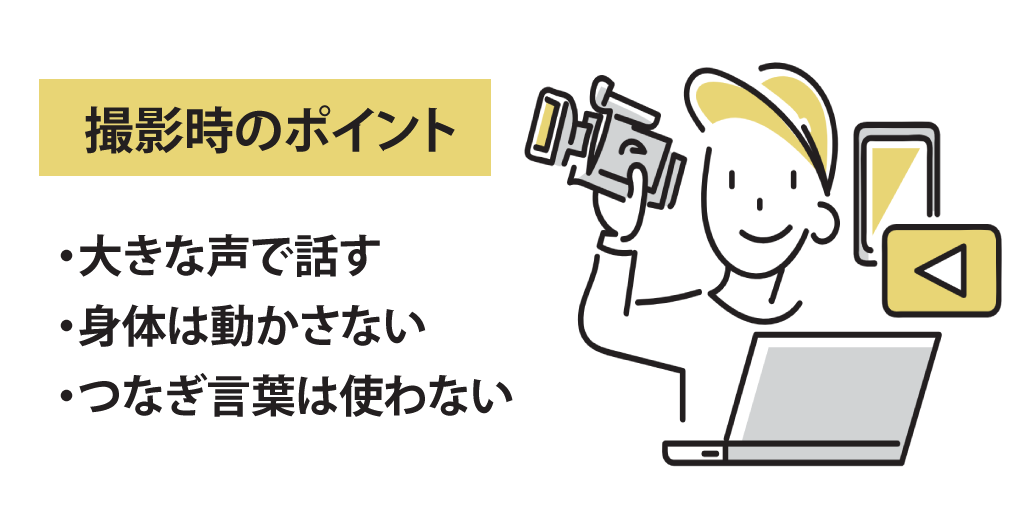
speak loudly
Video shooting is done in a variety of locations. While there are no problems when shooting in a quiet place, when shooting outdoors there are various noises such as the sound of passing cars, people talking, and even inside a building there are sounds of air conditioning and typing
Of course, it is best to film in a place where there are no such sounds, but first it is important to speak loud enough to be heard over the noise
Of course, it is possible to adjust the volume by editing the video, but this can result in distortion, environmental sounds being heard louder at the same time, and the voice sounding strange even if you edit it forcefully
So, try to speak in a voice that is a little louder than the volume at which you normally speak!
*People tend to speak quieter when they are deep in thought, so instead of thinking as you speak, try to be conscious of the volume of your voice by starting to speak once you have organized your thoughts
Do not move your body
Filming a video can be uncomfortable if you're not used to it. This can make you feel anxious or nervous, which can lead to shaking your body or fiddling with things with your hands
When you watch this kind of gesture throughout the video, it becomes a point that catches the viewer's eye in a bad way
To keep your body still, if you are standing, you can take a deep breath and puff out your chest slightly, and if you are sitting, you can keep your back straight and be aware of your posture at all times
This method is also recommended for those who have trouble sitting still, so please give it a try!
Don't use filler words
Transitional words like "ah" and "um" can be managed in video editing, so it's not like you should never use them during filming
However, if someone is speaking quickly or if multiple people are talking and their voices are overlapping, it may not be possible to cut it out even with editing
When filming, try not to start talking until you've decided what you want to say next, and make a conscious effort to take your time!
Specific learning methods
The quickest way to master this point is to show off to yourself
By convincing yourself that you can do it, your hunched back will naturally straighten, and your small, insecure voice will become louder and clearer
It may be hard to get used to at first, but gradually it will become normal and you will gain confidence! This is a recommended method, so please give it a try!
At the end, I've included a link to the YouTube channel I'm involved in, so I'd be happy if you could subscribe and give it a thumbs up!
The channel is at the link below:
https://www.youtube.com/c/beyomaruch
See you in the next blog! Bye!
 6
6 Loading...6



The person who wrote this article
About the author