

What causes high server load? How to identify the part that is under load
2016.02.25




My name is Ito and I am an infrastructure engineer
In our previous post, we introduced "load average," a metric used to check when server load increases.
Checking Server Load with Load Average - Beyond Blog
Load average represents the number of processes waiting to be processed.
The higher the number, the more processes are waiting to be processed, indicating a "high load" situation.
This time, I would like to explore the causes of high load situations
There are two main reasons for this:
There are basically two main reasons why a high load average occurs
- CPU processing cannot keep up
- Disk I/O processing cannot keep up
Now, I would like to explain how to find the cause of each of these
If the CPU is the cause
First, check the CPU usage using the top command. The following two values are important:
| %user | CPU usage by user processes |
| %system | CPU usage by the system (kernel) |
If a typical process is CPU intensive, you will likely see high CPU usage in user mode (%user)
Furthermore, user-mode processes, especially those running a large number of processes, perform process switching.
This "process switching" utilizes kernel-mode (%system) CPU resources, so
programs that frequently switch processes will likely have high kernel-mode CPU usage.
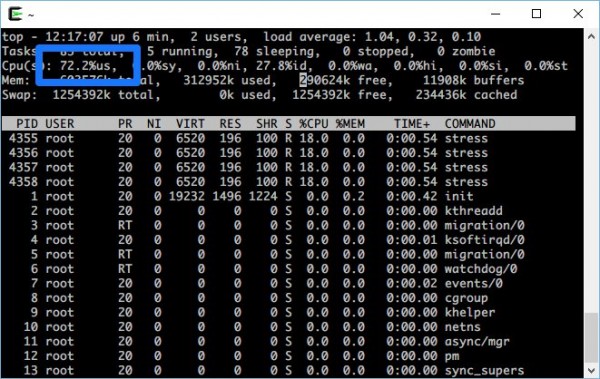
High user mode CPU usage
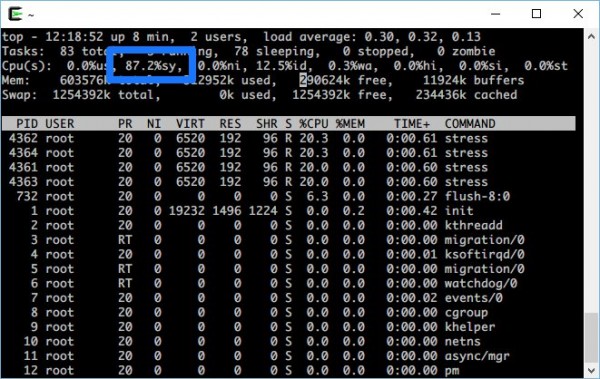
High kernel CPU usage
If the cause is disk I/O
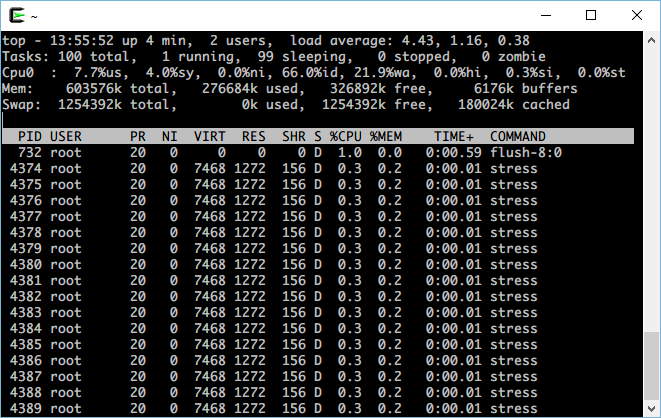
If disk I/O is the problem, check the following in top:
| %iowait | The process is idle when disk I/O is required |
| SWAP | The amount of memory used up and the HDD is being used instead of memory |
The iowait value often increases when there are large amounts of data being read from and written to the disk.
For example, a database server that frequently accesses the database will likely have a high iowait value.
SWAP is the amount of hard drive space used as backup memory when a process has used up all of its memory.
An example of using SWAP is a web server, which may allocate memory and use SWAP when there is a large number of accesses.
When using SWAP, the server will be slower because the HDD is used instead of memory, which increases the load on disk I/O
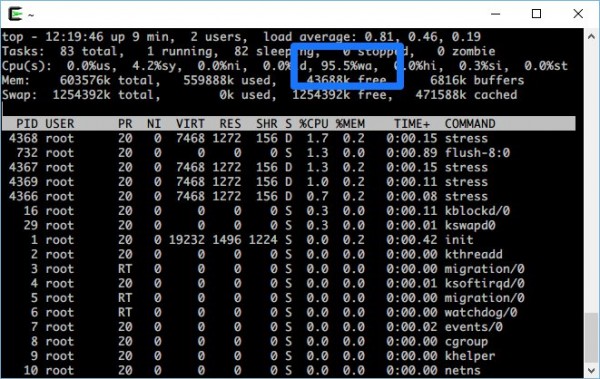
High iowait and high load due to disk I/O
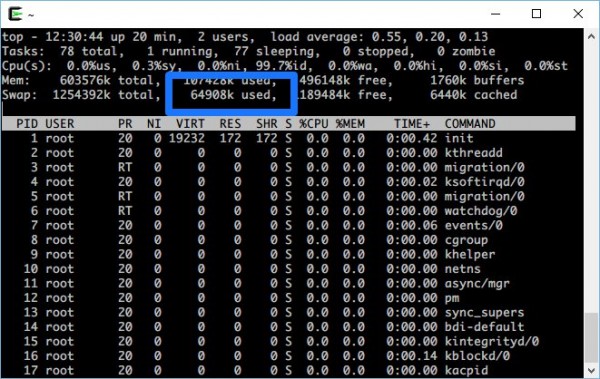
If you are using SWAP
We will investigate the cause
This should help you determine whether the problem is CPU-related or I/O-related. You
can then use commands like `ps` to find out which processes are using the CPU (or memory in the case of SWAP).
If the CPU usage is high in user mode, and there are no issues with I/O, then you
may need to either increase the CPU's performance or revise the program.
If there is a problem with the disk I/O, you may need to add more memory or review the program to perform processing in a location with available memory rather than using disk I/O
Additionally, you might experience slow processing even with a low load average.
In such cases, the issue could be related to software settings or network processing.
When you are faced with the problem of "high load," the first step to solving it is to stay calm and identify which part is under load
If you want to talk to a cloud professional
Since our founding, Beyond has used the technical capabilities we have cultivated as a multi-cloud integrator and managed service provider (MSP) to design, build, and migrate systems using a variety of cloud server platforms, including AWS, GCP, Azure, and Oracle Cloud
We provide a custom-made cloud server environment optimized for our customers based on the specifications and functions of the systems and applications they require, so if you are interested in the cloud, please feel free to contact us
● Cloud/Server design and construction
● Cloud/Server migration
● Cloud/Server operation, maintenance, and monitoring (24 hours a day, 365 days a year)
The person who wrote this article
About the author