

We participated in the Azure study group [Co-hosted by Microsoft] [Beyond Study Group]
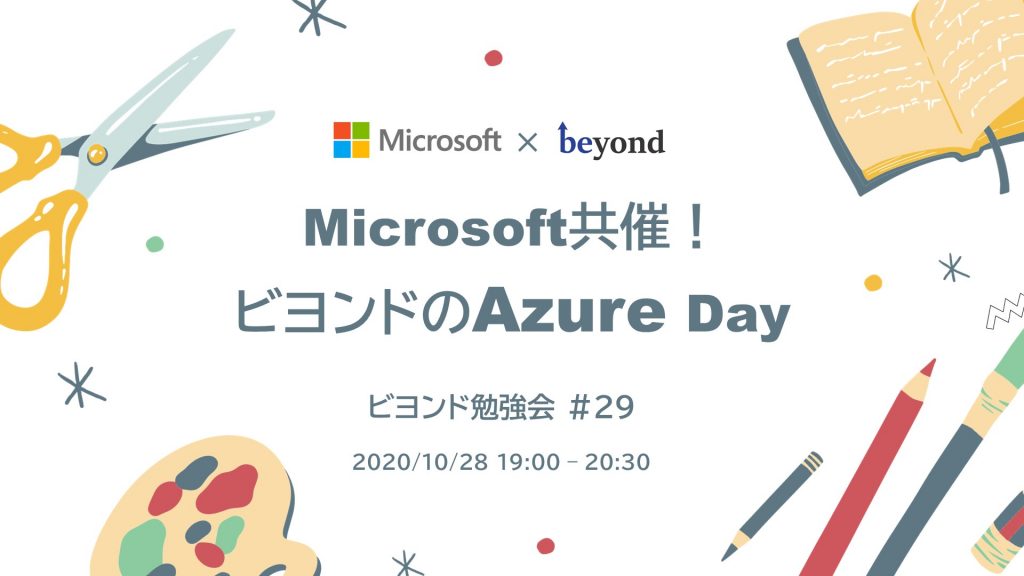
table of contents
- 1 What kind of study group is the Beyond Study Group?
- 2 First announcement: "Notifying Azure Monitor alerts to various communication tools"
- 3 Next presentation: "Load testing of AppService and Azure Database for MySQL"
- 4 Finally, Microsoft gave a presentation on "Azure infrastructure reliability and governance, which have evolved significantly over the past three years."
- 5 summary
- 6 lastly
Hello,
I'm Mandai, the Wild Team member of the development team.
On October 28, 2020, Beyond hosted a study session.
It was called the Beyond Study Session.
This time, it was co-hosted with Microsoft, and we had a fantastic event with a Microsoft representative on stage.
What kind of study group is the Beyond Study Group?
Beyond study groups are not specialized in a specific field, but rather are general study groups that cover any topic that comes to mind at the time.
This time, we discussed Azure, provided by Microsoft, which has recently become a major presence among the public clouds that Beyond specializes in.
I boldly asked him to speak, and he gladly accepted
First announcement: "Notifying Azure Monitor alerts to various communication tools"
The first speaker was Hirata from the System Solutions Department at Beyond,
who presented a solution to send notifications to various communication tools using Azure Monitor as the starting point.
Although email alert notifications are available by default, they are no longer a viable communication tool.
Now that communication using chat tools like Slack and Chatwork has become commonplace, it's time to try receiving alerts via chat.
One interesting feature was the call processing using Twilio, a service that can handle making and receiving phone calls and SMS
Everything can be driven by Azure Automation, and I was impressed by how powerful the service is and how flexible it can be
A video showing the machine in operation has also been released, so please enjoy it
Video: Notifying Azure Monitor alerts to various communication tools [Beyond Workshop #29] - YouTube
Slides: Slides
Next presentation: "Load testing of AppService and Azure Database for MySQL"
Next, from the development side, Mr. Hase from our System Development Department spoke about load testing of a web application running on Azure's App Service, a PaaS.
Some may wonder why we need to do load testing on a PaaS system. While load testing is one way of proving that a system can handle the expected load, it is also important to clarify in advance the load that a certain configuration can handle.
In this case, since the expected number of users was known, the main purpose was to measure the resources required to handle that number of users and find a line that would allow stable operation.
When load testing doesn't produce the expected results, the first thing to suspect is SQL.
This time too, we weren't satisfied with the results at first, so we had to go through a lot of trial
and error. The book explains how to set up a path through that process in a systematic way, and the final results were also very clear.
Watch the video here Load testing of AppService and Azure Database for MySQL [Beyond Workshop #29] - YouTube
Slides here Slides
Finally, Microsoft gave a presentation on "Azure infrastructure reliability and governance, which have evolved significantly over the past three years."
The final speaker was Mr. Masubuchi, a Global Black Belt Game Server Architect from Microsoft.
He gave a general overview of topics in the Azure world, but I was a bit taken aback when he suddenly started talking about space.
They asked me to talk about Azure.
They asked me to talk about the product.
This wasn't just because we wanted to talk about space, but because we were talking about Azure's space business, Azure Orbital
From there, let's move on to Azure, which we're all familiar with
The basics were just glossed over and I was told to read the documentation, but the site that was introduced was very well-designed
Developer tools, technical documentation, and code samples | Microsoft Docs
Speaking of Microsoft's documentation, I can't help but feel like I can't quite understand what it's saying, but this is well organized. What
I thought was great was that you can try it out using an actual Azure instance.
You can try out various things for free, so if you read through it and try it out, you'll probably gain a deeper understanding.
The second half of the lecture focused on Azure infrastructure reliability.
He introduced how Azure services are managed.
In particular, he talked about availability sets, fault domains, and update domains, which are distinctive features of Azure, and I thought that understanding these concepts would be extremely useful knowledge when building a system.
The conversation continues with SLAs, moving on to storage and PaaS (AppService WebApp).
There are many useful topics to learn, such as how the AppService backend has been updated and its specs have improved, and how using a feature called Application Insights can be useful for reviewing processing speeds.
He shared a lot of insight into large-scale projects that are unique to Microsoft (especially in the gaming industry, which is Masubuch's specialty), including the promotion of in-memory SQL Server, the behind-the-scenes of Minecraft Earth, which uses Cosmos DB, the weaknesses of Cosmos DB that were discovered there, and how to choose Azure Synapse Analytics as a workaround
There's so much to cover that I've had to summarize it all, so it's best to just take a look at the publicly available archives
Watch the video here: Azure Infrastructure Reliability and Governance Has Evolved Over the Past Three Years [Beyond Workshop #29] - YouTube
Slides here: Azure Infrastructure Reliability and Governance
summary
This workshop featured talks about Azure from both the service user and the service provider.
Those who normally use other public clouds likely had many questions.
At Beyond, we hold study sessions on a wide range of topics, including infrastructure as well as development
To participate in the study group, please use connpass or doorkeeper.
We recommend that you register as a member of each community so that you can easily check when study groups are being held.
Beyond Study Group - connpass
Beyond Study Group | Doorkeeper
lastly
I've launched "SEKARAKU Lab," a system development service site for which I work.
Beyond offers a one-stop service for everything from server design and construction to operation, so if you have any problems with server-side development, please feel free to contact us.
SEKARAKU Lab: [https://sekarakulab.beyondjapan.com/](https://sekarakulab.beyondjapan.com/)That's
all.
 0
0 Loading...0



The person who wrote this article
About the author