

Aggregating data from a specific period from a CSV file using Python [pandas]

Hello.
I'm Kawa from the Systems Solutions Department, and I have big dreams but a weak personality.
The weather has become quite pleasant, hasn't it?
So, this time, I'd like to use "pandas," a basic Python library for data analysis,
to aggregate a large amount of data from a CSV file.
environment
Operating System: Microsoft Windows 10 Pro
Python Version: 3.10.4
big picture
import pandas as pd from datetime import datetime as dt import collections import itertools df = pd.read_csv('<filename>.csv', usecols=['datetime', 'person_in_charge'], encoding='cp932' ) df_date = df.set_index('datetime') #For error checking def check(x): #print(x) pd.to_datetime(x) df_date.index.map(check) df_date.index=pd.to_datetime(df_date.index,format='%Y%m%d %H:%M') df_date.sort_index(inplace=True) df_date['count'] = 1 df_multi = df_date.set_index([df_date.index.year, df_date.index.month, df_date.index.weekday, df_date.index.hour, df_date.index]) df_multi.index.names = ['year', 'month', 'weekday', 'hour', 'date'] df_date['person_in_charge'] = df_date['person_in_charge'].str.split(',') all_tag_list = list(itertools.chain.from_iterable(df_date['person_in_charge'])) c = collections.Counter(itertools.chain.from_iterable(df_date['person_in_charge'])) tags = pd.Series(c) df_tag_list = [] top_tag_list = tags.sort_values(ascending=False).index[:11].tolist() for t in top_tag_list: df_tag = df_date[df_date['person_in_charge'].apply(lambda x: t in x)] df_tag_list.append(df_tag[['count']].resample('1M').sum()) df_tags = pd.concat(df_tag_list, axis=1) df_tags.columns = top_tag_list df_tags.to_csv('result.csv', encoding='cp932') print("done")
Purpose and preparation
The raw CSV file
is assumed to contain a large amount of data, including the date the inquiry was received (in yyyy/mm/dd format) and the name of the person who handled it.
As a preprocessing step, the date column is named "datetime" and the person in charge column is named "person_in_charge".
Since we will be using the pandas library,installation via pipis required.
(For other environments such as Anaconda, please refer to the link provided.)
Partial explanation
▼ Read the file with pandas. The csv file is in the same folder as the code file
df = pd.read_csv('<filename>.csv', usecols=['datetime', 'person_in_charge'], encoding='cp932' )
▼ Use df.set_index to assign the "datetime" column as the index.
*The latter part is for checking if there are any blank cells, so you can omit it.
df_date = df.set_index('datetime') def check(x): pd.to_datetime(x) df_date.index.map(check)
▼ Convert data type to datetime format & sort
df_date.index=pd.to_datetime(df_date.index,format='%Y%m%d %H:%M') df_date.sort_index(inplace=True) #Add a count column for resampling df_date['count'] = 1
※What is resampling? (External link)
▼ Grouping and counting by day or time
df_multi = df_date.set_index([df_date.index.year, df_date.index.month, df_date.index.weekday, df_date.index.hour, df_date.index]) df_multi.index.names = ['year', 'month', 'weekday', 'hour', 'date'] df_date['person_in_charge'] = df_date['person_in_charge'].str.split(',') all_tag_list = list(itertools.chain.from_iterable(df_date['person_in_charge'])) #Pass iterate to collection. Count the number of occurrences of each tag c = collections.Counter(itertools.chain.from_iterable(df_date['person_in_charge'])) #Convert to series tags = pd.Series(c)
※What is a series in pandas? (External link)
▼ Store tags in a DataFrame
df_tag_list = [] top_tag_list = tags.sort_values(ascending=False).index[:11].tolist()
▼ This is the key point: By changing the "'1M'" part of "df_tag_list.append(df_tag[['count']].resample('1M').sum())" to,
for example, "'2W'", you can aggregate every two weeks, or every seven days if you change it to "'7D'".
for t in top_tag_list: df_tag = df_date[df_date['person_in_charge'].apply(lambda x: t in x)] df_tag_list.append(df_tag[['count']].resample('1M').sum()) df_tags = pd.concat(df_tag_list, axis=1) df_tags.columns = top_tag_list
▼ Output aggregated data to a new file
df_tags.to_csv('result.csv', encoding='cp932') #When finished, print "done" print("done")
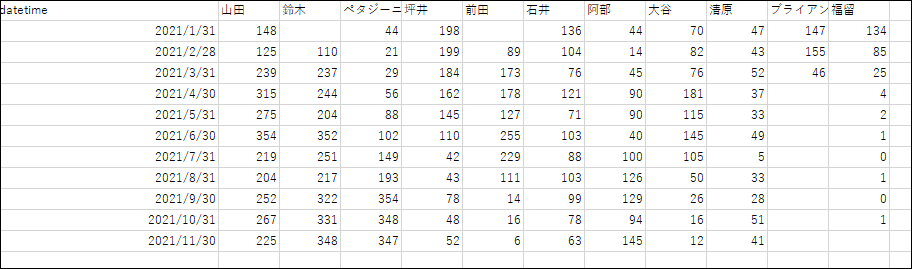
Output results
Here's the
monthly summary data broken down by person in charge. If needed, you can aggregate it by week or day, and
if you format it nicely, it could be used as data in meetings!
See you later!




The person who wrote this article
About the author