
What items do you handle in cloud server design & deployment?
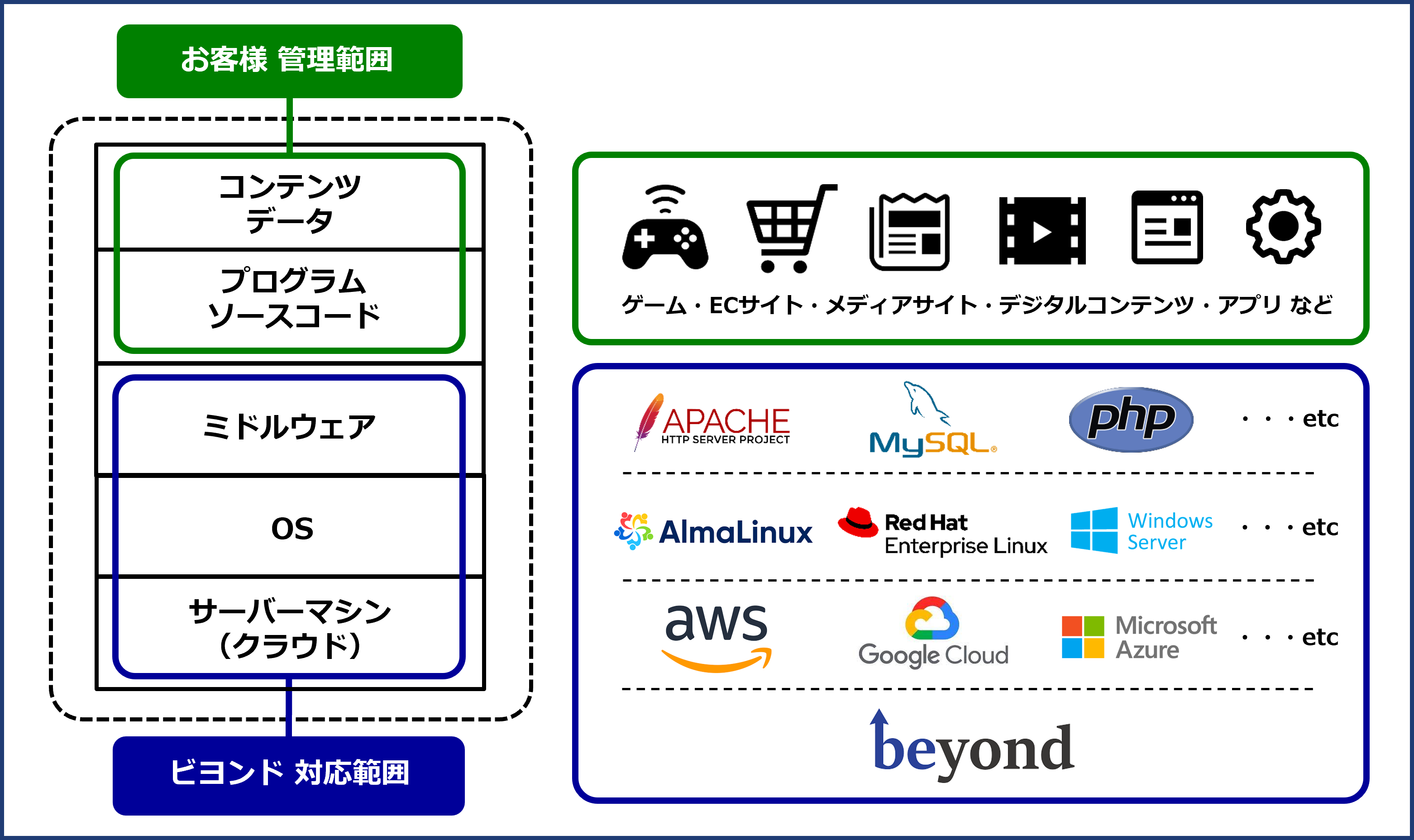
After the infrastructure design has been defined, including the number of cloud server hosts, their specifications, the OS/middleware versions to be installed, subnets, and security policies, the cloud server construction work will be carried out based on the contents of the infrastructure design
Once the initial construction of the cloud server is complete, we will provide you with a set of login and configuration information for the cloud server
● Cloud server design and construction
Cloud server design and construction support items
| Cloud server design and construction items | Cloud server configuration design | Server machine setup | OS / middleware / module installation and configuration |
| Subnet/Security Policy Settings | Login user account settings | IP address permission settings | |
| Virtual Host Configuration | Backup Settings (Internal Backup) | Monitoring tool settings (Zabbix) | |
| Server parameter sheet creation | Email/phone/chat support | Cloud usage fee billing service (Japanese yen, invoice payment) | |
| Server data migration *Optional | - | - |
*Please contact us if you have any requests regarding cloud server design and construction other than those listed above.
*Does not include work related to purchasing and installing domains, DNS, or SSL certificates.
What are the items covered in cloud server operation, maintenance, and monitoring?
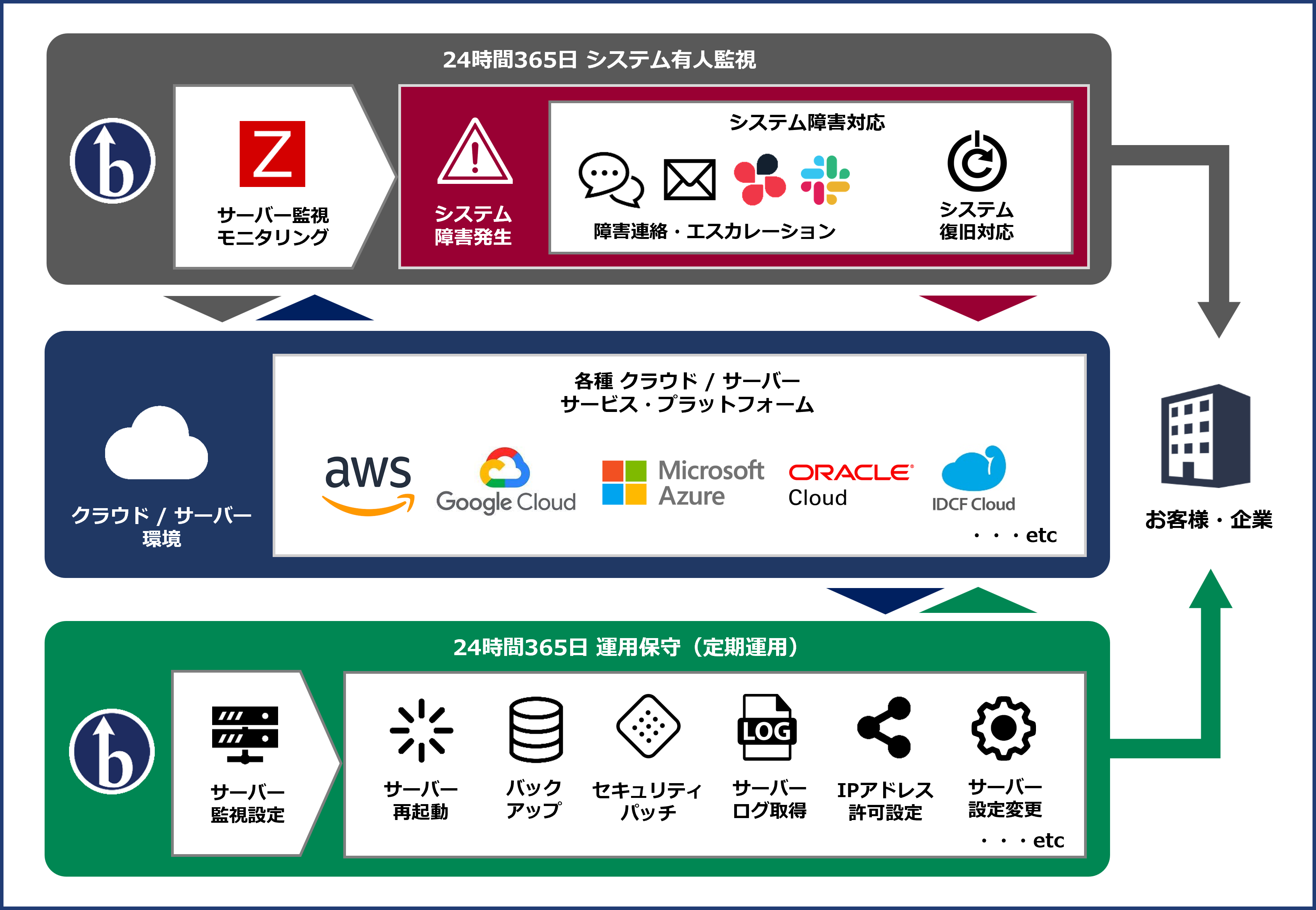
Our engineers are on-site 24 hours a day, 365 days a year to handle the operation, maintenance, and monitoring of your cloud servers, and we also provide rapid troubleshooting for any unexpected issues that may arise
We also analyze the operational status and trends of systems and applications, provide advice on potential future problems, and support the optimization of infrastructure configuration. By helping to prevent and improve operational problems before they occur, we can achieve more reliable cloud server operations
● Cloud server operation, maintenance and monitoring (24 hours a day, 365 days a year)
● Cloud server operation monitoring service (24 hours a day, 365 days a year)
Cloud server operation, maintenance and monitoring support items
| Cloud server basic support items |
24/7 engineer support | Email/phone/chat support | First response to problems (alert notification/cause investigation) |
| Secondary response to failures (failure isolation/failure recovery) | Cloud operation support (scaling instances, expanding disk volumes, creating IAM, etc.) | Technical support/advice regarding cloud configuration and functionality | |
| Cloud server operation and maintenance items | Server restart (machine/OS/middleware) | Adding and changing OS/middleware settings | Security policy additions and changes |
| Adding and changing login user accounts | Adding and changing IP address permission settings (including blocking invalid IP addresses) | Adding and changing virtual hosts | |
| Log acquisition (access.log/error.log, etc.) | Server monitoring items / alert threshold addition/change | Vulnerability response (version upgrades using package management tools such as yum) * Best effort response | |
| Middleware performance tuning * Best effort or optional | Technical support/advice on OS/middleware (OSS) * Best effort support | - | |
| Cloud Server Monitoring Items | Ping monitoring | Port Monitoring | Apache monitoring |
| SWAP monitoring | Disk Monitoring | CPU/LA monitoring | |
| URL Monitoring | Process Monitoring | Performance Monitoring | |
| Database Monitoring | - | - |
* If you have any requests for cloud server operation, maintenance, or monitoring services other than those listed above, please contact us separately.
* The minimum usage period for this service is 3 months.
Is there a limit to the number of times I can receive support for cloud server operation, maintenance, and monitoring?
There is no limit to the number of support requests for cloud server operation, maintenance, and monitoring. Also, there are no additional costs for exceeding the number of support requests
We provide support 24 hours a day, 365 days a year via email, phone and chat
● Cloud server operation, maintenance and monitoring (24 hours a day, 365 days a year)
● Cloud server operation monitoring service (24 hours a day, 365 days a year)
Does it support the deployment and operation of large-scale infrastructure?
Yes, we specialize in the deployment, operation, maintenance, and monitoring of infrastructure environments used for large-scale web service systems.
We support the design, deployment, and 24/7 operation, maintenance, and monitoring of infrastructure environments involving dozens or hundreds of servers (hosts). Of course, if the minimum number of servers is required, we can accept orders from just one server.
● Cloud server design and construction
● Cloud server operation, maintenance and monitoring (24 hours a day, 365
days a year) ● Cloud server operation and monitoring service (24 hours a day, 365 days a year)
● AWS cloud integration
● AWS operation monitoring service (24 hours a day, 365 days a year)
● Cloud server migration and migration
● North American cloud server construction, operation and maintenance
What are the differences between cloud servers and on-premise (physical) servers?
The following are some of the differences and comparisons between cloud servers and on-premise (physical) servers:
| Cloud Server Features | |
| Safety | - The hardware infrastructure (servers/network) is built in as standard, so there is little service interruption due to hardware failure |
| Operational aspect | - You can quickly build servers, add more servers, and upgrade their specifications regardless of the server location
- The server can be scaled out to accommodate high loads of access |
| Price | - Most cloud services charge a per-data-transfer amount, so monthly costs fluctuate
- Overseas cloud services such as AWS, Google Cloud (GCP), Azure, and Oracle Cloud have service usage fees that fluctuate depending on the monthly exchange rate |
| merit | - Resources can be added easily, as much as needed, when needed
- Even if the server configuration is minimal when the cloud is introduced, it is possible to upgrade or downgrade the specifications after the service starts |
| Disadvantages | - Because the hardware infrastructure and configuration are black boxes, it is difficult to identify the cause of hardware-related failures and to evaluate performance
- Data transfer is charged as you go, so monthly service fees may increase |
| comprehensive evaluation | - For web services and systems where the access load to the server changes suddenly, such as games, apps, e-commerce sites, media sites, and digital content, the cloud is suitable as it can quickly respond to adding resources and scaling out
- In terms of cloud reliability, most cloud services undergo annual audits by internationally accredited third-party auditing organizations to provide assurance about security, privacy, and compliance controls |
| On-premise (physical server) features | |
| Safety | - Since the data is stored in a physical environment, the location of the server is clear |
| Operational aspect | - Machine resources such as servers, firewalls, and load balancers can be exclusively used by one company, making it easy to customize the system to suit your company's requirements |
| Price | Although initial implementation costs are incurred, monthly costs are often fixed, making monthly cost management stable. However, there are indirect, invisible personnel costs involved, such as infrastructure maintenance man-hours, data center rack costs, electricity costs, and hardware manufacturer maintenance renewals |
| merit | ・Since it is exclusive to one company, it is not affected by other users' systems. ・The performance of the machine and resources, such as CPU/memory, is clear. |
| Disadvantages | ・There is a risk of server shutdown due to physical hardware failure. ・It is difficult to upgrade hardware resources. ・When initially introducing hardware, it takes time to size and estimate the system. |
| comprehensive evaluation | - Because it allows you to make maximum use of server machine/hardware resources, when developing mission-critical systems that do not use the external Internet, physical servers can maintain stable, high performance rather than the cloud
- Some studies have shown that performance evaluations compared to cloud services have shown that performance results are more than three times faster |
*Beyond can provide server operation, maintenance, and monitoring (24 hours a day, 365 days a year) even for on-premise (physical server) infrastructure environments
In addition, for the design and construction of on-premise (physical server) infrastructure environments and on-site support, we will work in collaboration with Beyond's infrastructure partners
● Cloud server design and construction
● Cloud server migration
● AWS cloud integration
What are the services provided by Beyond suitable for?
This service is suitable for companies that operate web services such as games, apps, e-commerce sites, media sites, and digital content, where speed and flexibility are particularly important and are directly linked to sales, companies that want to focus on content development and management, and companies that do not have a server administrator
Furthermore, companies facing such challenges tend to outsource their work to MSPs (managed service providers) like Beyond, which specialize in building, operating, maintaining, and monitoring cloud servers
● Cloud server design and construction
● Cloud server operation, maintenance and monitoring (24 hours a day, 365
days a year) ● Cloud server operation and monitoring service (24 hours a day, 365 days a year)
● AWS cloud integration
● AWS operation monitoring service (24 hours a day, 365 days a year)
● Cloud server migration and migration
● North American cloud server construction, operation and maintenance
What are the monitoring tools for operation, maintenance and monitoring?
The monitoring tool used for the operation, maintenance, and monitoring of cloud servers is Beyond's own Zabbix monitoring server, so customers do not need to prepare an additional server environment for Zabbix.
*You can also use "Amazon CloudWatch" according to your needs
● Cloud server operation, maintenance and monitoring (24 hours a day, 365 days a year)
● Cloud server operation and monitoring service (24 hours a day, 365 days a year)
● North American cloud server construction, operation and maintenance
Can you help me migrate server data from an existing server?
Yes, we undertake the migration of server data from on-premise, physical server, or legacy system environments to cloud environments
In addition to migrating data to the new cloud environment, we also thoroughly check to ensure that the database data is updated without any issues and that there are no problems with the operation of services or content
*Please note that a separate fee will be charged for the server data migration process
How long does it take to apply for cloud server-related services and start using them?
◇ If you are taking over an already-built cloud server or an operating system environment
, operation, maintenance, and monitoring can be completed within 7 to 10 business days after ordering the service.
◇ When designing and building a new cloud server
: After ordering the service, we can build the new server environment within 10 to 15 business days, and then handle operation, maintenance, and monitoring.
* Regardless of the pattern, once the monitoring settings on the cloud server are complete, we will provide you with a parameter sheet (settings information) for the server environment
*The above delivery dates are estimates only. Schedules and delivery dates may vary depending on the system configuration and circumstances. Please contact us for details
● Cloud server design and construction
● Cloud server operation, maintenance and monitoring (24
hours a day, 365 days a year) ● Cloud server operation monitoring service (24 hours a day, 365 days a year)
● AWS cloud integration
● AWS operation monitoring service (24 hours a day, 365 days a year)
Is technical support for OS/middleware available?
Yes, we provide design, construction, and technical support for OSS (open source software) used in LAMP environments (CentOS, AlmaLinux, Apache, MySQL, PHP, etc.), as well as technical support for parameter tuning
*For commercial operating systems/middleware such as Windows and Oracle, we will provide support on a best-effort basis
● Cloud server design and construction
● Cloud server operation, maintenance and monitoring (24 hours a day, 365
days a year) ● Cloud server operation and monitoring service (24 hours a day, 365 days a
● AWS cloud integration
● AWS operation monitoring service (24 hours a day, 365 days a year)
● North American cloud server construction, operation and maintenance
Are OS/middleware security updates (vulnerability fixes) available?
Yes, if a highly urgent security vulnerability is discovered and it is determined that an immediate response is required, we will coordinate with you to schedule the security update and then carry out the security update
*Security updates and version upgrades are supported using package management tools such as yum
● Cloud server operation, maintenance and monitoring (24 hours a day, 365 days a year)
● Cloud server operation monitoring service (24 hours a day, 365 days a year)
What is the security system for cloud server operation, maintenance, and monitoring?
We provide cloud server operation, maintenance, and monitoring services based on the basic information security policy of ISMS (ISO/IEC 27001:2022 an international standard for third-party certification
Obtained ISMS (ISO/IEC 27001:2022) certification, an international standard for third-party certification of information security management systems.
◇ Operation, maintenance and monitoring bases
: Osaka, Shikoku and Canada
◇ Internal network environment for operation, maintenance and monitoring
Dedicated network line for operation, maintenance and monitoring work and connected via fixed IP address
Antivirus software installed on all employee PC terminals
◇ Operation, maintenance and monitoring work structure:
3 shifts (including nighttime hours, weekends and holidays)
◇ Response to OS/middleware vulnerabilities:
Collection and distribution of OS/middleware vulnerability information provided by JPCERT/CC
◇
Only authorized personnel are allowed to enter the office (entry and exit controlled by security card authentication)
● Cloud server operation, maintenance and monitoring (24 hours a day, 365 days a year)
● Cloud server operation monitoring service (24 hours a day, 365 days a year)
What is the lineup of cloud servers that you support?
We provide the optimal cloud server environment to meet your needs, regardless of the cloud server platform, such as AWS, Google Cloud (GCP), Microsoft Azure, Oracle Cloud (OCI), IDCF Cloud, etc. You can also entrust us with the construction and operation of multi-cloud configurations
For details on supported cloud servers, please see below
● Cloud Partner/Cloud Support List
● Cybersecurity Support List
Can you also handle operation, maintenance, and monitoring of services other than cloud (hosting, VPS, etc.)?
Yes, even in server environments such as hosting, VPS, and rental servers, as long as you have an environment where you can connect remotely via SSH or RDP ports, Beyond can provide operation, maintenance, and monitoring services
However, please note that the operational maintenance and monitoring support items may be limited depending on your system environment and specifications
● Cloud server design and construction
● Cloud server operation, maintenance and monitoring (24 hours a day, 365 days a year)
I'm in trouble because my company's server administrator has left the company
There is no problem as Beyond will act as the administrator of the cloud server environment on your behalf
By entrusting your business to Beyond, you can benefit from specialized cloud server technology and know-how without having to incur new recruitment costs or labor in-house
● Cloud server operation, maintenance and monitoring (24 hours a day, 365 days a year)
● Cloud server operation monitoring service (24 hours a day, 365 days a year)
Is it possible to continue supporting the current server environment as is?
Yes, we can take over your currently operating cloud or server environment and provide operation, maintenance, and monitoring. In this case, we will install and configure the Zabbix
Additionally, if Beyond detects any problems with the configuration or performance of your infrastructure environment during its operation, maintenance, and monitoring, we will propose parameter reconfigurations and tuning to improve infrastructure operations
● Cloud server operation, maintenance and monitoring (24 hours a day, 365 days a year)
● Cloud server operation monitoring service (24 hours a day, 365 days a year)
Is emergency contact and technical support available by telephone 24 hours a day, 365 days a year?
Yes, Beyond's server engineers operate, maintain, and monitor cloud servers in three shifts, 24 hours a day, 365 days a year, so we are able to provide technical support over the phone, even in the early morning or late at night.Of course, we also provide technical support via email and chat
● Cloud server operation, maintenance and monitoring (24 hours a day, 365 days a year)
● Cloud server operation monitoring service (24 hours a day, 365 days a year)
● AWS cloud integration
● AWS operation monitoring service (24 hours a day, 365 days a year)
Is it possible to have engineers on-site to handle in-house system construction and troubleshooting?
Unfortunately, Beyond does not build systems for on-premise environments within customers' companies or provide on-site support (working at customers' premises)
All cloud server environment construction, migration, operation, maintenance and monitoring will be handled remotely
Is it possible to define system requirements for cloud server design & deployment?
Yes, we will listen to and advise you on the system specifications and security requirements of your services and applications, and define the prerequisites for your cloud server environment
However, please note that we do not hold frequent requirements definition meetings (participate in regular meetings) or create requirements definition documents
● cloud server design & deployment
● Cloud server operation, maintenance and monitoring (24 hours a day, 365 days a year)
● Cloud server operation and monitoring service (24 hours a day, 365 days a year)
● Cloud server migration
Can you also manage the purchase, acquisition, and renewal of domains and SSL certificates?
Yes, we have a wide range of domains and SSL certificates available. Of course, we also undertake installation and renewal of SSL certificates on cloud/servers
● Domain/DNS acquisition and management
● SSL certificate acquisition and management
Please tell me the process for migrating server data
When migrating from your current server to the cloud, we will select the new cloud server to be introduced, thoroughly identify bottlenecks and risks during data migration, and determine the work process and schedule, including database and content data synchronization methods, system downtime, DNS switching work, and operation confirmation
| Server data migration process (example) | |
| Beyond Work | 1. Interview and definition2 . Survey of current server environment *Connection information to current server is required3 . Adjustment of data migration schedule4 . Design and construction of new server environment to which data will be migrated (machine setup, OS/middleware installation, etc.) 5. First data migration from current server to new server (import of full data) 6. Service/system operation check (first time) 7. Second data migration from current server to new server (import of differential data) *Involves system downtime for maintenance8 . Service/system operation check (second time) 9. DNS server record switching/redirection *Or this can be done by the customer10 . Creation of a parameter sheet for the new server |
| Customer work | 1. Adjusting the schedule for data migration 2. Applying for a new server 3. Program modifications and upgrades to current services and systems *Please take action as necessary 4. Creating a maintenance page *As this involves a system outage, please make preparations as necessary 5. Switching DNS server records and changing destinations *Or have Beyond do this 6. Checking the operation of the service and system 7. Removing and canceling the current server |
*The above server transfer/migration process is an example. The server transfer method will vary depending on your system environment, so we will respond in a way that meets your needs.
*This service requires a separate fee for server data transfer. Please see below for details.
Can you perform load testing on a cloud server?
Yes, at Beyond, we use Apache JMeter to create and run test plan scenario files (jmx files) either by the customer or at Beyond, and we will perform and support load tests that simulate the load of the production environment
◇ Load testing and support process
1. Defining the expected load and performance goals
2. Load test design (throughput goals, etc.)
3. Creating load test scenarios
4. Building the load test environment
5. Implementing the load test
6. Reviewing and investigating the load test
7. Creating documentation of the load test results
◇ If the goal is not reached, continue the following steps until the goal is reached
- Check for and correct any problems with the load test design
- Check for and correct any problems with the program implementation, server settings, or database design
- Retest
*This service requires a separate fee for load testing. Please see below for details
I'm suffering from a cyber attack
Systems and applications are constantly under attack from the outside
In order to prepare for cyber-attack emergencies and strengthen security on a daily basis, it is necessary to implement at least the following specialized security measures to minimize problems and damage
○ WAF protects against external internet attacks
○ IPS/IDS protects servers and internal networks from malware
○ Regularly perform vulnerability assessments of applications
Is it possible to design and build an on-premise server (physical server)?
We regret to inform you that Beyond does not design and build on-premise (physical servers) or provide on-site support. We only design and build infrastructure environments that allow for remote work, such as cloud, hosting, and VPS
Even in on-premise (physical server) infrastructure environments, we can provide server operation, maintenance and monitoring (24 hours a day, 365 days a year)
Can you design and build a CI/CD/DevOPS pipeline?
Yes, we also provide design, construction, and technical support for CI/CD and DevOPS pipelines using tools such as Jenkins, CircleCI, Ansible, and Terraform
● AWS cloud integration
● Kubernetes (k8s) design, construction and operation
Are there any initial costs if I take over operation, maintenance, and monitoring from my own company or another company?
Yes, there is an initial fee from Beyond
Whether you are taking over a server environment from your own company or another company, the following initial tasks will be required
◇ Installation of the agent for Beyond's monitoring server (Zabbix) in the server environment to be monitored
◇ Setting the alert threshold for the monitoring server
◇ Investigation of the settings of the existing server environment
● Cloud server operation, maintenance and monitoring (24 hours a day, 365 days a year)
● Cloud server operation monitoring service (24 hours a day, 365 days a year)
● AWS operation monitoring service (24 hours a day, 365 days a year)
Are there any volume discounts for the monthly operation, maintenance and monitoring fees?
If the number of servers (hosts) or roles subject to cloud server operation, maintenance, and monitoring is large, volume discounts may be available
Please contact us using the inquiry form
● Cloud server operation, maintenance and monitoring (24 hours a day, 365 days a year)
● Cloud server operation monitoring service (24 hours a day, 365 days a year)
● AWS operation monitoring service (24 hours a day, 365 days a year)
Does it support server deployment and operation using AlmaLinux?
Yes, we also support the construction, operation and maintenance of cloud servers using the AlmaLinux OS
Alma Linux is an open source Linux distribution developed as a fork of RHEL (Red Hat Enterprise Linux), and is characterized by its compatibility with RHEL and CentOS
Please feel free to contact us for server data migration and replacement from CentOS
● Cloud server design and construction
● Cloud server operation, maintenance and monitoring (24 hours a day, 365 days a year)
● Cloud server operation and monitoring service (24 hours a day, 365 days a year)
Cloud server migration and migration
● AlmaLinux OS server design and construction service
● CentOS server migration solution
● North American cloud server construction, operation and maintenance
Can you design, build, and operate Kubernetes and Docker containers?
Yes, Beyond supports the design, construction, operation and maintenance of Kubernetes and Docker container environments
We have experience in designing, building, operating and maintaining the following container environments. Please contact us for details
◇ Amazon Elastic Container Service (ECS) + AWS Fargate
◇ Amazon Elastic Kubernetes Service (EKS) + AWS Fargate
◇ Google Kubernetes Engine (GKE)
◇ Alibaba Cloud Container Service for Kubernetes (ACK)
◇ Oracle Cloud Infrastructure Container Engine for Kubernetes (OKE)
● AWS cloud integration
● Kubernetes (k8s) design, construction and operation
Can I purchase servers, network equipment, PCs, software, etc.?
Yes, you can purchase hardware products such as servers, network devices, and PCs from a variety of manufacturers, as well as software products. When considering purchasing a product or requesting a quote, please let us know the product name and model number of the hardware or software you are interested in
In addition, depending on the timing and quantity of product sales, we may be able to offer special manufacturer prices. For more information, please feel free to contact us using the inquiry form
Can I participate in a competition?
Unfortunately, Beyond does not prepare RFPs (requests for proposals) or proposals for participating in competitive projects
However, we can provide you with Beyond's service materials and resources for documents that you create and submit
Do you handle the construction and operation of cloud servers for overseas companies?
Yes, we provide cloud server construction, operation and technical support to customers, mainly Japanese companies, local subsidiaries and overseas group companies in overseas areas
Each of Beyond's wholly owned subsidiaries (Japanese companies) provides global standard services that take advantage of their location
North America
Company name: Beyond GTA Inc. (Canadian subsidiary)
Location: Toronto, Canada
Service area: North America (USA/Canada)
● North American Cloud Construction, Operation and Maintenance
Chugoku area
・Company name: Beyond Technology Shenzhen Co., Ltd. (local subsidiary in China)
・Location: Shenzhen, China
・Available areas: China (inner China / Hong Kong / Macau / Taiwan), Singapore, overseas Chinese regions
● Cloud infrastructure construction, operation, and maintenance in China
We are troubled by the rising cost of cloud services due to the weak yen
Most foreign cloud services require payments in USD (US Dollars), so they are greatly affected by exchange rates
To reduce your monthly cloud usage fees, we recommend that you consider the following methods
① Optimization of cloud resources
, deletion of unnecessary cloud resources
, optimization and automation of resources
② Review your subscription plan
, utilize reserved instances
, and utilize spot instances
3. Compare infrastructure services
, choose cloud providers
, and use on-premise infrastructure.
④ Strengthening cost awareness within the company
, improving cost awareness and training
, and reducing invisible costs
● [Countermeasures against the weak yen] How to cut costs on cloud usage fees
Tell me about Amazon EC2

Amazon EC2 is a computing service provided by AWS as virtual servers. Servers are managed in units called instances, and new instances can be created by simply clicking a few buttons in a browser or entering commands from a CLI (command line interface). This significantly shortens the preparation time for procuring server machines compared to physical servers (on-premises)
Amazon EC2 Features
● Scalable computing resources
You can launch as many instances as you need when you need them, and stop them when you no longer need them. You can also change resources such as increasing or decreasing the performance of your instances as needed.
● Secure Cloud Server
AWS security features are available to safely host data and applications, such as instance-level security groups, network ACLs, and IAM.
● Global infrastructureYou
can use AWS's global infrastructure.By using AWS regions and availability zones (AZs), you can provide low-latency services to users around the world.
● Preset AMI
By using AMI, you can get a pre-installed OS such as Linux or Windows, as well as applications, which allows you to quickly start up your applications.
● Various instance types
A variety of different types are available, including CPU, memory, storage, and network, so you can choose the type that is best suited to each application.
● Charges based on resource usage
Charges are based on the amount of time an instance is used and the amount of data transferred, so you can use only the resources you need for the amount of time you need.
Functions combined with Amazon EC2
● Autoscaling
The autoscaling function provides the ability to automatically scale instances up or down depending on the load of the application, allowing you to quickly and automatically respond to increases or decreases in the number of users.
By installing a load balancer at the top of the load balancing
● Storage
You can attach storage services such as EBS and EFS, allowing you to store application data efficiently and securely.
● GPU Instances
GPU instances enable you to perform advanced computing tasks such as machine learning and data analysis.
Beyond AWS related services
● AWS cloud integration
● AWS operation monitoring service (24 hours a day, 365 days a year)
Tell me about Amazon RDS
Amazon RDS is a managed RDB service provided by AWS. You can choose from a variety of database engines, including MySQL, PostgreSQL, MariaDB, Microsoft SQL Server, and Oracle Database
AWS also offers Amazon Aurora, an RDS service with an architecture developed by AWS that maximizes the benefits of the cloud. One of the major benefits of using Amazon RDS is that it streamlines operational tasks such as data backups and hardware maintenance, which can often be complicated
Amazon RDS features
● Managed services
Because the database is a managed service provided by AWS, database management, patch application, security updates, hardware updates, etc. are performed automatically, minimizing database management work.
● Improved availability
By using the Multi-AZ feature of Amazon RDS, you can automatically fail over to another availability zone without stopping your application, which is expected to improve the fault tolerance and availability of your database.
● Automatic backup
We provide an automatic backup (snapshot) function for the database. Automatic backup processing is performed daily. In addition, data can be restored as needed within the set retention period, preventing data loss in the unlikely event of an accident.
● Security
To ensure database security, we provide a number of security functions, including database encryption, access control, and audit logs.
Amazon Aurora Features
● Scalability
Amazon Aurora supports vertical and horizontal scaling. Vertical scaling allows you to increase resources such as CPU, memory, and storage of an instance. Horizontal scaling allows you to create read replicas to offload read processing for queries.
● High-speed processing of large amounts of data
Amazon Aurora provides high-speed read and write performance. It uses advanced technologies such as multi-threading, page caching, and online log replay to achieve high-speed performance even when processing data for large-scale applications.
● Supports automatic sharding
Sharding is a method of dividing a database, and is effective when handling large amounts of data. By dividing data by shard key (a key for dividing data), for example, if the customer ID is the shard key, data for the same customer will be stored in the same shard.
With sharding, Amazon RDS Aurora divides your data across multiple instances, with each instance serving queries against its own shard, providing increased scalability and load balancing
Amazon RDS Aurora supports automatic sharding, which allows Amazon RDS Aurora to automatically partition your data to provide optimal performance. You can also configure manual sharding, which gives you control over how your data is distributed
Beyond AWS related services
● AWS cloud integration
● AWS operation monitoring service (24 hours a day, 365 days a year)
Tell me about Amazon S3

Amazon S3 is an object storage service with extremely high durability and unlimited data capacity. It differs from file storage in that it has a flat structure without a directory structure and allows users to add their own information (metadata) to their data
Amazon S3 objects are accessed using HTTP-based Web APIs such as REST and SOAP. Not only is it used by users to store data, but it is also used as a backend service for AWS, such as the data storage destination for EBS snapshots, making it a very important service within AWS
Amazon S3 Features
● Scalable object storage
Amazon S3 stores files and data as objects, which are stored in containers called buckets, and each object is assigned a unique key. Amazon S3 is also a highly scalable service, capable of handling petabytes of data.
● Durability and availability
Because data is stored in multiple regions, it features extremely high data durability, with a guaranteed durability of 99.999999999% (11 9s) and availability of 99.9%.
● Security:
Data security is a major focus, and data can be encrypted before storage. Access control can also be performed using ACLs (Access Control Lists) and IAM roles.
● Flexibility:
It supports a variety of data formats to accommodate different applications and workloads, and it can be used for a variety of purposes because it is compatible with other AWS services.
Amazon S3 Features
● Uploading and downloading files
Amazon S3 makes it easy to upload and download files. Files uploaded to Amazon S3 have a unique URL, and can be downloaded by knowing that URL.
● Data Protection
You can protect your data using object ACLs, and Amazon S3 offers SSL encryption and server-side encryption.
● Versioning:
Object versioning is supported. By enabling versioning, you can store multiple versions of the same key. This allows you to revert to a previous version even if you accidentally overwrite data.
● Lifecycle Management
Lifecycle management of objects allows you to define operations such as automatic deletion or migration to a different storage class based on information such as creation date and time, update date and time, and access date and time.
● Event notifications
Supports event notifications for object operations. By configuring event notifications, notifications will be sent to AWS services such as Amazon SNS and Amazon SQS, or HTTP endpoints when operations on buckets or objects occur, such as creating, deleting, or updating objects.
● Cross-region replication
Cross-region replication allows you to automatically create copies of your objects in another AWS region to ensure redundancy.
● Storage ClassesAmazon
S3 offers multiple storage classes, such as the Standard Storage Class (S3 Standard), the Infrequent Access Storage Class (S3 Standard-IA), and the Archive Storage Class (S3 Glacier).Each storage class allows you to choose cost-effective storage depending on the frequency of data access and retention period.
Beyond AWS related services
Tell me about Amazon Cloudfront

Amazon Cloudfront is a CDN (Content Delivery Network) that caches static content such as HTML files, CSS, images, and videos, and delivers content instead of origin servers. AWS has over 400 edge locations, and using Amazon Cloudfront allows you to deliver content quickly from the edge location closest to your service users
If the origin server processes large files such as images and videos every time they are accessed, the load on the server increases. This makes it difficult to provide stable content delivery, which causes inconvenience to service users
By using Amazon Cloudfront, you can reduce the load on your servers while delivering stable content, creating a system that benefits both service providers and service users
Amazon CloudFront features
● Fast content delivery
Amazon CloudFront delivers content cached in edge locations to the closest users, ensuring fast content delivery and minimizing user wait times and delays. It uses the AWS global network to provide high-speed network connections.
● Customizable Delivery
Amazon CloudFront offers many customizable delivery features, such as content caching control, content compression, SSL/TLS encryption, and domain name customization.
● Security
By combining with other AWS services, we offer a number of security features to protect content from unauthorized access, such as application layer protection using AWS WAF and defense against DDoS attacks using AWS Shield.
Beyond AWS related services
● AWS cloud integration
● AWS operation monitoring service (24 hours a day, 365 days a year)
● Amazon CloudFront construction, operation, maintenance and monitoring service
What is Amazon Route 53?

Amazon Route 53 is a service that provides AWS domain management and authoritative DNS functions. You can configure and manage domain and zone information from the web console or web API. In addition to managing domain and DNS information, it also improves availability and response with various functions such as network traffic routing and changing connection destinations based on the status of the connected system
Amazon Route 53 Features
● High availability and low latency
Amazon Route 53 is a global DNS service with high availability. It uses servers across multiple geographic regions, ensuring that user requests are handled correctly even in the event of a failure. The AWS global network also allows requests to be routed to the closest server, minimizing latency and delays for users
● Scalability
Our fast and reliable DNS service can handle millions of clients and billions of requests, and can automatically scale traffic up and down to handle large and sudden spikes in traffic
● Managing DNS records
You can register domain names and set, update, and delete DNS records from the AWS Management Console. You can also manage your DNS records using the CLI or API.
● Traffic routing:
By controlling traffic routing, you can distribute traffic across different regions and different endpoints. It also supports custom routing policies such as weighted routing, geographic routing, latency routing, and failover routing.
● Health Checks
: Health checks of endpoints allow you to monitor the availability of an endpoint and automatically redirect traffic to an alternative endpoint in the event of a failure. Health checks can be performed over HTTP, HTTPS, TCP, or a combination of HTTP and HTTPS.
● Security
Amazon Route 53 provides features to ensure the security of DNS queries. DNSSEC ensures that DNS queries have not been tampered with. In addition, when combined with Route 53 Resolver, applications within a VPC can use the DNS resolver to connect to other AWS services.
● Monitoring:
We provide real-time monitoring of changes to DNS records, traffic changes, etc. You can also use Amazon CloudWatch to monitor Amazon Route 53 health checks and traffic changes. You can also use AWS CloudTrail to check Amazon Route 53 activity logs.
● Integration with AWS services
Amazon Route 53 supports integration with other AWS services. For example, you can associate public IP addresses held by Amazon EC2 instances, ELB (Elastic Load Balancing), Amazon CloudFront, etc. with DNS names to route traffic. You can also host static websites and distribute content to Amazon S3 buckets.
Beyond AWS related services
What is Amazon CloudWatch?

Amazon CloudWatch is a managed service that helps monitor system resources and application operations to ensure stable operation after system construction and release, and regularly obtains the status (metrics) of each AWS release
For example, you can set standard metrics predefined by AWS, such as the CPU usage of an EC2 instance or the number of errors per Lambda function, or you can create your own custom metrics by passing user-defined values to Amazon CloudWatch
Amazon CloudWatch features
● Monitoring
Amazon CloudWatch monitors the real-time operation status of various AWS resources, such as Amazon EC2 and Amazon RDS. It can collect various metrics, such as CPU usage and network traffic, allowing system administrators to understand the usage and performance of various AWS resources.
● Alert Notifications
Metrics are monitored regularly and alerts are sent when thresholds are exceeded, allowing you to quickly respond to problems with AWS resource status and troubleshoot issues. You can set alert thresholds for collected metrics and receive alerts when those thresholds are exceeded. Alerts can be sent via email, SMS, Slack, or other tools.
● Log collection and storage
Collecting and storing application logs, system logs, security logs, etc. from various AWS resources such as Amazon EC2 and Amazon RDS can be useful for application troubleshooting, security investigations, etc. In addition, by using the Amazon CloudWatch Logs agent, you can also collect and store logs from on-premises servers and custom applications.
● Display of metrics
Metrics can be displayed graphically, allowing you to understand resource usage in real time. You can also freely customize the time axis, graph type, and metrics displayed on the graph, and add the displayed graph to a dashboard.
● Security
Amazon CloudWatch also contributes to the security of various AWS services. For example, logs collected from AWS CloudTrail can be automatically sent to Amazon CloudWatch Logs, enabling security monitoring such as aggregating important security information.
● Application tracing
Amazon CloudWatch can be integrated with AWS X-Ray, allowing you to trace your applications and analyze their performance. You can visualize the flow of requests and processes within your application and collect metrics such as latency, error rates, and throughput.
Beyond AWS related services
● AWS cloud integration
● AWS operation monitoring service (24 hours a day, 365 days a year)
Tell me about AWS Lambda
AWS Lambda is an event-driven computing service that allows you to run programs without provisioning servers, and is a core service of serverless architecture
By directly invoking events from over 200 AWS services and applications using AWS Lambda as a trigger, you can automatically execute your code when an event occurs, such as an HTTP request via Amazon API Gateway, an object change in an Amazon S3 bucket, or a DynamoDB table update
In addition, AWS Lambda automatically scales according to the number of requests, so you don't have to worry about the infrastructure required for data processing, and you can expand resources as traffic increases
All functions that maintain high availability, such as code execution and scaling, are managed by AWS Lambda, so customers can simply upload their application code to scale AWS services using custom logic or build their own backend services
AWS Lambda features
● Choice of development language
AWS Lambda supports multiple programming languages, including Java, C#, and Python, so developers can choose a language that suits their skills.
● Creating a function
Use the AWS Lambda console or AWS CLI to create a Lambda function, which is a unit of code that will be executed in response to a trigger.
● Setting a trigger Set
the event that will trigger the function. Triggers can be selected from AWS services such as API Gateway, S3, DynamoDB, and CloudWatch.
● Function execution
When a trigger occurs, the Lambda function is executed, performs the necessary processing, and returns a response. It also automatically scales according to the number of requests, ensuring high availability.
● Logging and Monitoring
You can collect Lambda function logs and store them in CloudWatch Logs, allowing you to view and troubleshoot Lambda function execution logs.
AWS Lambda trigger types
● API Gateway
allows you to send HTTP requests to Lambda functions, making it easy to build RESTful APIs.
●
Lambda functions can be triggered when an S3 object is created or deleted, or when the object's metadata is changed.
●
You can trigger a Lambda function when a CloudWatch metric exceeds a certain threshold.
●
A Lambda function can be triggered when data is inserted, updated, or deleted in a DynamoDB table.
●
By triggering a Lambda function when creating or updating a CloudFormation stack, you can automatically deploy and configure applications.
●
A Lambda function can be triggered when an SQS message is added to a queue, enabling asynchronous communication between components of a distributed system.
● CloudTrail
Lambda functions can be triggered in response to administrative activity in your AWS account, automating tasks such as security monitoring and vulnerability detection.
●
Real-time data processing is achieved by triggering a Lambda function when data becomes available in the Kinesis stream.
● When IoT
sensor data is collected, a Lambda function is triggered to process the data from the IoT device.
● Alexa Skills Kit
You can use Lambda functions to create custom skills for Amazon Alexa.
Beyond AWS related services
● AWS cloud integration
● AWS operation monitoring service (24 hours a day, 365 days a year)
● Serverless application design and development service
What is AWS IAM?
AWS IAM (AWS Identity and Access Management) is used by AWS users when they log in to the web console and operate AWS using the web API. You can define which services each IAM user is allowed or not allowed to operate, so you can use AWS more safely by properly restricting the permissions of each IAM user
For example, you can create an IAM user that is granted only the permission to Start/Stop EC2 instances, but not the Terminate operation, or you can create an IAM user for network administrators that only has permission to manage networks within the cloud (such as Security Groups and VPCs). Managing IAM users is a key security feature when using AWS
AWS IAM Features
● User management function
You can manage users within your AWS account. You can create new users and change the access permissions of existing users. You can also create and manage groups and roles within your AWS account.
● Access permission management function
You can set detailed access permissions for AWS resources. Access control rules called policies are used to control which AWS resources users can access. AWS IAM also manages authentication information for accessing AWS services.
● Authentication feature
This feature issues the authentication information required to access AWS resources. You can issue an access key and secret access key for each user in your AWS account. These keys are used to access resources via the AWS API.
● Auditing feature:
Provides an auditing function for access control within AWS accounts. By integrating with AWS CloudTrail, you can track API requests and collect detailed logs of actions within your account. This allows you to track actions, identify problems, and monitor security.
● Multi-account management function
You can manage multiple AWS accounts by grouping AWS accounts and setting roles. By using the multi-account management function, you can segment the management of AWS resources and expect to improve security.
Beyond AWS related services
Tell me about Amazon SES

Amazon SES is an email sending service provided by AWS with high email delivery performance. In addition to sending emails via the SMTP protocol or API, it can also receive emails and store them in Amazon S3
Amazon SES also enhances its defense against threats from viruses and spam by storing information such as "blocking large volumes of emails sent from specific IP addresses in a short period of time" and "asking each IP address and domain for a reputation based on their past activity history and not accepting emails sent from IP addresses with low reputations" in a database and sharing it worldwide
Amazon SES features
● Scalability:
Amazon SES is designed to deliver billions of emails per day, automatically scaling to accommodate the volume of email you send. It also runs on a highly available and durable global infrastructure, ensuring reliable email delivery and virtually no missed email deliveries.
● SecurityIt
has features to prevent email address spoofing and the delivery of spam emails. Amazon SES supports SSL/TLS, so sent emails are securely encrypted. It also supports SPF, DKIM, and DMARC authentication methods for email filtering, making it possible to detect and reject fraudulent emails.
●
Supports programmatic email delivery via a custom API and AWS SDK. You can send emails using your own domain name, improving the reliability of email delivery. It also supports email delivery with SMTP authentication, and you can use the SMTP endpoint provided by Amazon SES to deliver emails from multiple sender addresses.
● Low cost
Amazon SES charges a service fee based on the number of emails delivered, so it can be used and delivered at low cost even when sending large volumes of email.
Amazon SES features
● Email Templates
We provide the ability to create and manage email templates. By using templates that can customize email text, HTML, and multipart messages, you can deliver consistent messages. You can also customize individual messages by including dynamic values in email templates.
● Email Campaign Management
: Provides statistics on the emails you send, including the number of recipients, delivery success rate, delivery failure rate, open rate, click rate, etc. You can use these statistics to track the performance of your email campaigns.
● Controlling email delivery
Before sending an email, you can control whether it will be sent to specific domains or whether emails with specific subjects or body text will be sent. It also supports access control using AWS IAM, so that only users with the necessary permissions can use Amazon SES functions.
Services provided by Beyond
Tell me about Amazon ElastiCache
Amazon ElastiCache is an in-memory database service provided by AWS. It helps improve system performance by storing frequently referenced data or data sets that require time to search in memory. Amazon ElastiCache supports two engines, Redis and Memcached, so you can choose the engine that best suits your system's needs
Amazon ElastiCache features
● Managed service
Amazon ElastiCache is a managed service managed by AWS, so the procedures required for deployment, management, and monitoring are automated, and it also supports backing up data using snapshots. This means that system administrators do not need to configure or maintain it themselves.
● High speed
Both Redis and Memcached can be used. Redis supports advanced data structures and provides functionality similar to an RDB (relational database), while Memcached provides a simple key-value store.
These data stores cache data in memory, accelerating database read operations, enabling your application to provide fast and scalable responses
● Automatic disaster recovery:
With multiple nodes across multiple AZs (Availability Zones), there is no SPOF (single point of failure). In addition, an automatic disaster recovery function is provided, so even if the data store goes down, it will be automatically restored.
● Security:
Data stores can be placed in a private network using Amazon VPC, protecting them from unauthorized access via the Internet, and SSL/TLS encryption is supported.
Services provided by Beyond
● AWS cloud integration
● AWS operation monitoring service (24 hours a day, 365 days a year)
What is AWS Direct Connect?
AWS Direct Connect is a dedicated line connection service provided by AWS that does not use the internet. It connects the AWS cloud environment to the end of a dedicated line or private network provided by a line carrier (NTT, KDDI, Softbank, etc.) at an AWS Direct Connect location
AWS Direct Connect can be used between AWS cloud environments (EC2, VPC, S3, etc.) and your company's internal system facilities via a private network connection
AWS Direct Connect Features
● Private connection
AWS Direct Connect connects your AWS cloud environment to your on-premises environment through a private network that does not traverse the internet. This allows for a stable network connection and allows for high-speed transfer of large amounts of data. You can also select the network bandwidth that meets your business needs, allowing for flexible bandwidth scaling.
● Secure Connections
We provide secure connections using encrypted networks when connecting to AWS from data centers or offices. The network is protected by AES-256 encryption and BGP authentication, making it easy to control security.
Global connectivity:
AWS Direct Connect's network is global, providing connectivity to AWS regions in many regions, allowing users to connect to AWS from on-premises environments or third-party data centers.
● Various connection options
We offer physical connection options and virtual interface options. Physical connections connect to the AWS cloud using a dedicated physical line. Virtual interface options allow you to create a virtual connection and connect multiple VPCs.
Services provided by Beyond
Tell me about AWS CloudFormation
AWS CloudFormation is an Infrastructure as Code (IaC) service that allows you to model, automatically deploy, and version-manage AWS and third-party resources by treating AWS infrastructure configuration as code. AWS resources built by AWS CloudFormation are called stacks, and stacks are built based on blueprints in JSON or YAML format called templates
By modifying the template and applying it again with a specified stack, you can change the settings of AWS resources on the stack or delete resources.You can also use the same template to create a new AWS environment in a different region as a different stack
By describing the required resources and their dependencies in a CloudFormation template, you can launch and configure them all at once as a single stack. You can use the template whenever needed to create, update, or delete the entire stack as a single unit, eliminating the need to manage resources individually. You can also manage and provision stacks across multiple AWS accounts and AWS regions
AWS CloudFormation features
● Coding infrastructure
AWS CloudFormation allows you to represent infrastructure as code and create templates. Templates include definitions of AWS resources, the relationships between those resources, and the parameters for configuring them. Instead of creating resources manually, you can deploy resources defined in code. Because AWS resources are automatically created and configured, it provides greater consistency and reliability than doing it manually.
Versioning:
You can manage multiple versions of templates, compare different versions, track changes, and roll back if necessary. You can also export specific versions of templates or save them to an S3 bucket for release management.
Scalability:
AWS CloudFormation is designed to support large-scale applications and supports a large number of AWS resources. You can also manage resources not supported by AWS CloudFormation by using custom resources created with AWS Lambda functions.
Services provided by Beyond
● AWS cloud integration
● Kubernetes (K8s) design, construction and operation services
What is Beyond's phone number?
If you are considering introducing Beyond's services for the first time, please use
the inquiry form (At Beyond, we do not disclose the main contact phone number in order to focus on work efficiency.)
Please rest assured that when you introduce or use Beyond's services, we will provide you with a dedicated phone number for inquiries and support
What is Amazon Lightsail?

Amazon Lightsail is a virtual private server (VPS) provided by AWS that allows you to use cloud resources such as instances, containers, storage, and databases for a low, cost-effective monthly fee
Compared to other AWS services, Amazon Lightsail simplifies its functionality and provides easy-to-use cloud resources that allow you to build websites and applications with just a few clicks
Easily create and launch instances with pre-configured OS and application/development stacks like LAMP and WordPress by clicking a button. You can also use Amazon Lightsail's built-in firewall to allow or restrict traffic based on source IP, port, and protocol
Amazon Lightsail features
● Easy setup
Amazon Lightsail can be used without prior knowledge of AWS's advanced cloud services. With just a few clicks from the dashboard, you can easily deploy a virtual machine running Linux or Windows Server OS and create web applications and databases from pre-prepared application templates.
● Integrated management
It allows you to manage various services such as web applications and databases in an integrated manner. From a simplified dashboard, users can perform the minimum monitoring of resource status and change security group settings.
● Scalability
Resources such as web applications and databases can be scaled up or down as needed, allowing you to flexibly respond to sudden increases or decreases in traffic.
● Security
You can control access to resources using security groups and firewalls. Security features such as HTTPS encrypted communication and network interface level access control are provided.
● Backup and Restore
The automatic backup function allows you to automatically back up resources such as web applications and databases, and restore them as needed.
Services provided by Beyond
● AWS cloud integration
● AWS operation monitoring service (24 hours a day, 365 days a year)